
An online store may know what thousands of customers searched for, which products they viewed, what they bought, and what they returned. A SaaS company may have years of login activity, feature usage, subscription data, and support tickets.
Collecting all that information is relatively easy. Knowing what to do with it is harder.
That is where data science comes in.
Data science helps organizations turn raw information into something useful. Sometimes the result is a report or forecast. Sometimes it is a recommendation system, fraud alert, customer churn prediction, or a feature built directly into a software product.
What Is Data Science?
Data science is a field that uses statistics, programming, mathematics, and subject knowledge to collect, prepare, explore, and analyze data so that useful insights, predictions, or decisions can be made.
The important part is not simply having a large amount of data. Data science starts with a question and uses the available data to find a useful answer.
AWS describes data science as a multidisciplinary approach that combines mathematics, statistics, artificial intelligence, and computer engineering to extract meaningful insights from data. IBM similarly emphasizes statistics, programming, analytics, machine learning, and subject expertise.
For example, a subscription business could ask:
Which customers are most likely to cancel next month?
A data scientist can study previous customer behavior, look for patterns associated with cancellations, and build a model that helps the business identify accounts that may be at risk.
That is a much more practical way to think about data science than simply describing it as “working with big data.”
How Does Data Science Work?
Most data science projects begin with a problem, not an algorithm.
A simple process looks like this:
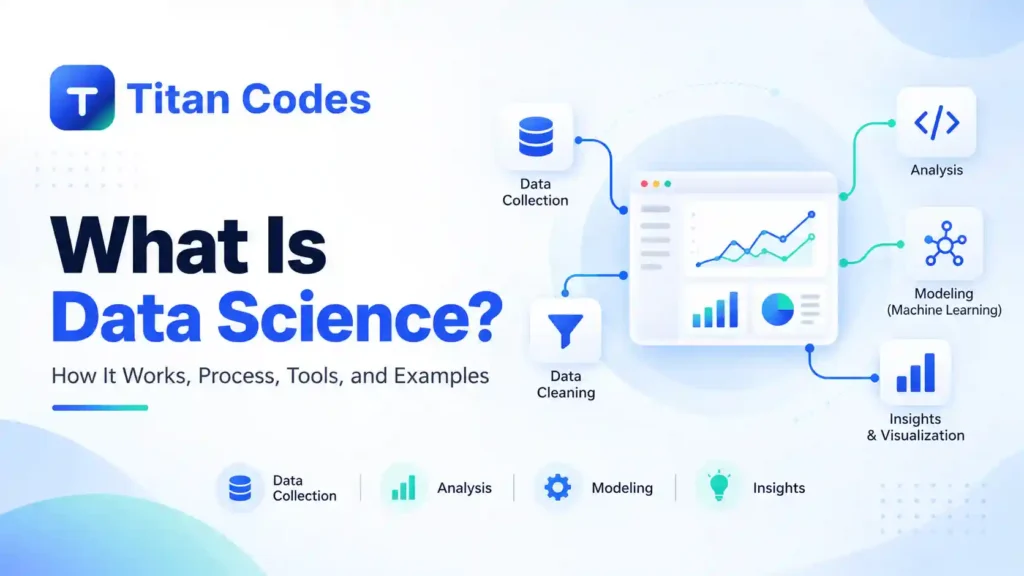
Business Question → Data Collection → Data Cleaning → Exploration → Analysis or Modeling → Evaluation → Result → Business Action
Suppose an ecommerce company wants to predict which products will sell well during the next holiday period.
The team might collect past sales, website traffic, promotions, product prices, inventory levels, and seasonal information. That data first needs to be checked and cleaned. The team can then explore patterns, test different approaches, and create a forecast.
The final result might be used by an inventory system so purchasing teams know which products need additional stock.
The useful part is not the model itself. The value comes when the result helps someone make a better decision.
What Is the Data Science Process?
There is no single process that every data science team follows exactly, but most projects move through similar stages.
1. Define the Problem
Before touching the data, the team needs to know what it is trying to answer.
“Analyze our customer data” is too broad.
A better question is:
Which customers have a high risk of cancelling their subscription during the next 30 days?
That question gives the project direction. It also makes it possible to decide what data is needed and whether the final result is useful.
2. Collect the Data
Data can come from many places.
A company may use information from its database, CRM, ecommerce platform, mobile application, website analytics, support system, APIs, financial tools, or external datasets.
The source depends entirely on the problem being solved.
A churn project might need subscription history and product usage. A delivery forecast might need orders, locations, traffic, and seasonal information.
3. Clean and Prepare the Data
Real business data is rarely ready to analyze immediately.
There may be duplicate records, missing values, different date formats, spelling variations, incorrect fields, or information spread across several systems.
Data preparation can involve correcting errors, removing duplicates, combining datasets, handling missing information, and converting data into a consistent format.
This work may not sound as exciting as building predictive models, but poor-quality data can ruin the rest of the project.
4. Explore the Data
Once the data is usable, the next step is to understand what is inside it.
A data scientist might look at distributions, trends, unusual values, relationships between variables, or groups of similar records.
Charts and simple statistics are often useful here.
For example, a SaaS company may discover that customers who stop using one particular feature are much more likely to cancel within the following month.
That insight may be useful even before a predictive model is built.
5. Analyze the Data or Build a Model
The next step depends on the question.
Some problems can be answered with statistics and visualization. Others require techniques such as regression, classification, clustering, forecasting, or machine learning.
This is an important distinction.
Not every data science project needs machine learning.
Sometimes a clear SQL query and a well-designed analysis are enough.
6. Evaluate the Result
A model producing an answer does not mean the answer is good.
The team needs to test whether the result is accurate enough for the intended use.
It also needs to ask practical questions.
Would the result still be useful with some errors? Does it perform well across different types of customers? Is the data introducing bias? Has information from the future accidentally been used to predict the past?
Evaluation is where a promising experiment either becomes useful or goes back for more work.
7. Put the Result to Work
The final step is often overlooked.
A prediction sitting inside a notebook does not help much by itself.
The output may need to appear in a dashboard, trigger an alert, feed another application, generate a recommendation, or become part of an existing business workflow.
At that point, data science begins to overlap with software engineering, APIs, databases, and cloud infrastructure.
What Are the Main Types of Data Analysis?
One useful way to understand data science is by the type of question being answered.
| Type | Question | Simple Example |
| Descriptive | What happened? | Sales fell last month |
| Diagnostic | Why did it happen? | Sales fell after website traffic declined |
| Predictive | What might happen next? | Forecast demand for next month |
| Prescriptive | What should we do? | Recommend the best inventory level |
These categories often work together.
A company may first identify that customer churn increased, investigate why it happened, predict which customers are likely to leave next, and then decide which customers should receive additional support.
AWS also uses descriptive, diagnostic, predictive, and prescriptive analysis when explaining common approaches to data science.
Common Data Science Techniques
Different problems require different methods. A few techniques appear particularly often.
Classification
Classification places something into a category.
Examples include:
Spam or not spam
Fraudulent or legitimate transaction
Likely to churn or likely to stay
Regression
Regression is commonly used when the result is a numerical value.
For example:
Predicting a house price
Estimating future revenue
Forecasting delivery time
Clustering
Clustering finds groups of similar records without starting with predefined labels.
A retailer might use clustering to discover groups of customers with similar buying behavior.
Time-Series Analysis
Time-series techniques are useful when information is recorded over time.
Common examples include forecasting sales, website traffic, energy usage, or inventory demand.
Natural Language Processing
Natural language processing deals with text and language.
It can be used to classify support tickets, analyze customer feedback, search documents, summarize text, or identify common topics in thousands of reviews.
Recommendation Systems
Recommendation systems try to identify items a user may find relevant.
They are widely used for products, movies, music, articles, jobs, and other content.
What Tools Are Used in Data Science?
There is no single “data science tool.” Different tools handle different parts of the work.
| Purpose | Common Tools |
| Programming | Python, R |
| Querying data | SQL |
| Data manipulation | Pandas, NumPy |
| Visualization | Matplotlib, Tableau, Power BI |
| Machine learning | scikit-learn, TensorFlow, PyTorch |
| Interactive analysis | Jupyter Notebook |
| Large-scale processing | Apache Spark |
| Databases | PostgreSQL, MySQL, NoSQL databases |
| Cloud infrastructure | AWS, Microsoft Azure, Google Cloud |
| Version control | Git |
Python has become particularly useful because one language can handle data cleaning, analysis, visualization, machine learning, automation, and connections to other software.
IBM also identifies Python, R, SQL, Spark, TensorFlow, PyTorch, and visualization tools among technologies commonly used in data science.
A beginner does not need to learn all of these at once.
Python, SQL, Pandas, basic statistics, and visualization are already enough to start working on useful projects.
Data Science vs Data Analytics vs Machine Learning vs AI
These terms overlap, which is why they are often confused.
| Field | Main Focus |
| Data Science | Using data to produce insights, predictions, and useful systems |
| Data Analytics | Examining data to answer questions and understand what happened |
| Machine Learning | Teaching systems to find patterns in data and make predictions |
| Artificial Intelligence | Building systems that perform tasks associated with intelligent behavior |
| Data Engineering | Building pipelines and systems that collect, move, store, and prepare data |
Data science is the broadest of these in many business contexts.
Machine learning can be part of a data science project, but it is not required for every project.
Data engineering is also different. A data engineer may build the pipeline that moves millions of records into a data warehouse. The data scientist can then use that prepared information for analysis or modeling.
AWS makes a similar distinction, describing data analytics as a subset of the broader data science process and data engineering as the work of building and maintaining the systems that make data available for analysis.
What Is Data Science Used For?
Data science is easier to understand through real problems than abstract definitions.
Customer Churn Prediction
Subscription businesses can analyze product usage, payments, support history, and account activity to identify customers who may stop using the service.
Fraud Detection
Banks, payment companies, and ecommerce platforms can look for unusual transaction patterns that may indicate fraud.
Recommendation Systems
Online stores can recommend products based on browsing and purchase behavior. Streaming platforms use similar ideas to suggest movies, music, or other content.
Demand Forecasting
Retailers and manufacturers can use historical data to estimate future demand and plan inventory.
Customer Segmentation
Businesses can group customers according to buying behavior, usage patterns, demographics, or other characteristics.
Predictive Maintenance
Equipment data can help manufacturers identify signs that a machine may fail before the failure actually occurs.
Search and Personalization
Data can be used to improve search results, rank content, personalize experiences, and recommend the next useful action.
A Real-World Data Science Example: Predicting SaaS Churn
Imagine a SaaS company has noticed that cancellations are increasing.
The team has several years of customer information, including login frequency, features used, subscription plan, support tickets, billing history, and previous cancellations.
The first step is to define what “churn” means. For example, a customer who cancels a paid subscription.
Next, the team prepares the historical data and looks for patterns.
It might discover that customers who log in less frequently, stop using a key feature, and open several support tickets are more likely to cancel.
A model can then estimate churn risk for active customers.
But the project should not end with a spreadsheet of probability scores.
The useful version could surface high-risk accounts inside the company’s customer success system so the team knows where to focus its attention.
The model produces the prediction. The surrounding software makes that prediction usable.
How Is Data Science Used Inside Software Products?
Data science does not always appear as a separate dashboard or research project.
Often, it sits quietly inside the product.
An ecommerce platform may use it for recommendations. A SaaS product may use it to identify churn risk. A logistics application may forecast demand. A support system may automatically categorize incoming tickets. A search product may use behavioral data to improve ranking.
Turning those ideas into production features usually involves more than data analysis.
The system may also need databases, APIs, authentication, scheduled data pipelines, monitoring, cloud infrastructure, and a user interface.
That connection is important for Titan Codes because data-driven features often become part of a wider software product rather than remaining isolated experiments. Titan Codes builds custom software, SaaS platforms, cloud-ready products, and connected business systems where data can become part of the actual workflow.
Explore Titan Codes software development services
What Does a Data Scientist Do?
A data scientist’s day can look very different depending on the company.
One day may involve writing SQL to collect data. Another may involve cleaning a dataset in Python, building a predictive model, discussing a business problem with another team, or explaining results to someone who does not work with data every day.
Common responsibilities include understanding business questions, preparing data, running experiments, creating visualizations, building models, checking results, and communicating what the analysis means.
In larger organizations, data scientists may work closely with data engineers, analysts, software developers, and machine learning engineers. In smaller teams, one person may handle several of those responsibilities. IBM also highlights business understanding as an important part of the role, not just programming and statistics.
What Skills Does a Data Scientist Need?
Good data science combines technical skills with the ability to understand the problem behind the data.
Mathematics and Statistics
Probability, distributions, correlation, regression, sampling, and statistical testing help data scientists judge whether patterns are meaningful.
Programming
Python and R are commonly used for manipulating data, running analyses, and building models.
SQL
Much of a company’s useful data lives in databases. Knowing how to query it is one of the most practical skills a data scientist can have.
Data Visualization
Charts help people see patterns that are difficult to understand from rows of numbers.
Machine Learning
Machine learning becomes useful when the project involves prediction, classification, recommendations, or more complex pattern recognition.
Business Understanding
This is easy to underestimate.
A technically impressive model that answers the wrong question is still a bad data science project.
Knowing how the business works helps a data scientist decide which problems are worth solving.
What Are the Benefits of Data Science for Businesses?
The biggest benefit is not simply “more data.”
It is better use of the data a business already has.
Data science can help companies understand customer behavior, forecast demand, identify risk, improve products, automate repetitive decisions, personalize experiences, and find patterns that are difficult to spot manually.
It can also challenge assumptions.
A product team may believe one feature keeps customers subscribed. Usage data may show that another feature has a much stronger relationship with retention.
That does not mean every decision should be handed to an algorithm. It means teams have more evidence available when making important decisions.
What Are the Challenges of Data Science?
Real-world data science is often messier than tutorials make it look.
Poor Data Quality
Missing, incorrect, duplicated, or inconsistent data can make analysis unreliable.
Fragmented Data
Useful information may be spread across databases, spreadsheets, CRM systems, analytics tools, and third-party platforms.
Bias
Historical data can contain biases that influence analysis and model results. Models need to be evaluated carefully rather than assumed to be objective.
Privacy and Security
Customer, employee, financial, or other sensitive data needs appropriate access controls and governance.
Changing Behavior
Patterns do not remain fixed forever. Customer behavior, market conditions, products, and processes change, which means models may need to be monitored and updated.
Getting the Work Into Production
A model that works inside a notebook may still need significant engineering before thousands of users can depend on it.
AWS identifies several similar challenges, including working with multiple data sources, understanding the underlying business problem, and addressing bias in data and models.
Does Data Science Always Require AI or Machine Learning?
No.
Data science can involve statistics, SQL analysis, experimentation, visualization, forecasting, and other methods without using machine learning or AI at all.
Machine learning becomes useful when the problem benefits from learning patterns from existing data.
For example, a business can calculate last month’s average order value with SQL and basic statistics. It does not need a machine learning model.
Predicting which customers are likely to make a purchase next month may be a better candidate for machine learning.
Using a more complicated technique does not automatically make the answer better.
How Is Cloud Computing Used in Data Science?
Data science projects can require a lot of storage and computing power, particularly when datasets become large.
Cloud platforms make it possible to access storage, databases, data processing tools, notebooks, machine learning services, and specialized computing resources without buying all of the physical infrastructure in advance.
A team might keep raw data in cloud storage, process it with a managed data platform, train a model using cloud compute, and make the result available through an API.
IBM notes that cloud computing helps data science scale by providing additional processing power, storage, and supporting tools.
If cloud concepts are still new to you, Titan Codes also has a beginner guide explaining what cloud computing is and how it works.
For businesses building production systems, Titan Codes also works with databases, deployment, monitoring, backups, and cloud infrastructure for websites and digital products.
Explore Titan Codes Cloud Services
How Can Beginners Start Learning Data Science?
Do not begin by trying to learn every machine learning algorithm.
Start with the foundations.
Learn basic statistics and become comfortable with Python. Then learn SQL so you can work with data stored in databases. Practice cleaning datasets with Pandas and creating simple visualizations.
Once those skills start to feel natural, move into exploratory data analysis and basic machine learning.
Most importantly, work on actual datasets.
Pick a question such as:
Which products sell best by month?
or:
Which factors appear most closely related to customer churn?
Clean the data, explore it, create a few charts, and explain what you found.
That small project will teach you more about data science than memorizing a long list of algorithms.
Frequently Asked Questions About Data Science
What Is Data Science in Simple Words?
Data science is the process of using data to answer questions, find patterns, make predictions, or support decisions. It combines skills such as statistics, programming, data analysis, and knowledge of the problem being studied.
What Is an Example of Data Science?
Customer churn prediction is one example. A subscription company can analyze customer activity, billing history, product usage, and past cancellations to estimate which active customers are more likely to cancel in the future.
Is Data Science the Same as AI?
No. Data science is a broader field focused on extracting useful information from data. AI focuses on systems that perform tasks associated with intelligence. Data science may use AI or machine learning, but many data science projects do not require either.
Does Data Science Require Coding?
Most professional data science work involves some coding. Python, R, and SQL are commonly used. Beginners can still learn basic data analysis with spreadsheets and visualization tools, but programming becomes increasingly important for larger datasets, automation, and machine learning.
Which Programming Language Is Best for Data Science?
Python is one of the most widely used choices because it has a large ecosystem for data manipulation, visualization, statistics, and machine learning. R is also widely used, particularly for statistics and research.
What Is the Difference Between a Data Scientist and a Data Analyst?
A data analyst often focuses on understanding existing data and producing reports or insights about what happened. A data scientist may work on broader problems involving statistical modeling, experimentation, prediction, and machine learning. The responsibilities can overlap depending on the company.
Final Thoughts
Data science is not simply about collecting huge datasets or building complicated machine learning models.
It starts with a useful question.
From there, the work is about finding the right data, cleaning it, understanding what it says, choosing an appropriate method, and turning the result into something people can actually use.
Once you see data science that way, it becomes much easier to understand where statistics, programming, machine learning, software, and business knowledge all fit together.