
Search for how to become a data scientist, and you will quickly end up with a long list of things you are apparently supposed to know.
Python. SQL. Statistics. Machine learning. Tableau. Cloud. Deep learning. Git. Data engineering.
For someone starting out, that list is more confusing than helpful.
You do not need to learn everything at once. A better approach is to build the fundamentals in the right order, work with real data early, and gradually move from analysis into more advanced modeling.
There is also good reason to consider the field. In the US, the Bureau of Labor Statistics projects employment for data scientists to grow 35% between 2025 and 2035, with about 24,800 openings per year on average during that period.
This guide explains what to learn, which skills matter most, what projects to build, and how to prepare for your first data science role.
How Do You Become a Data Scientist?
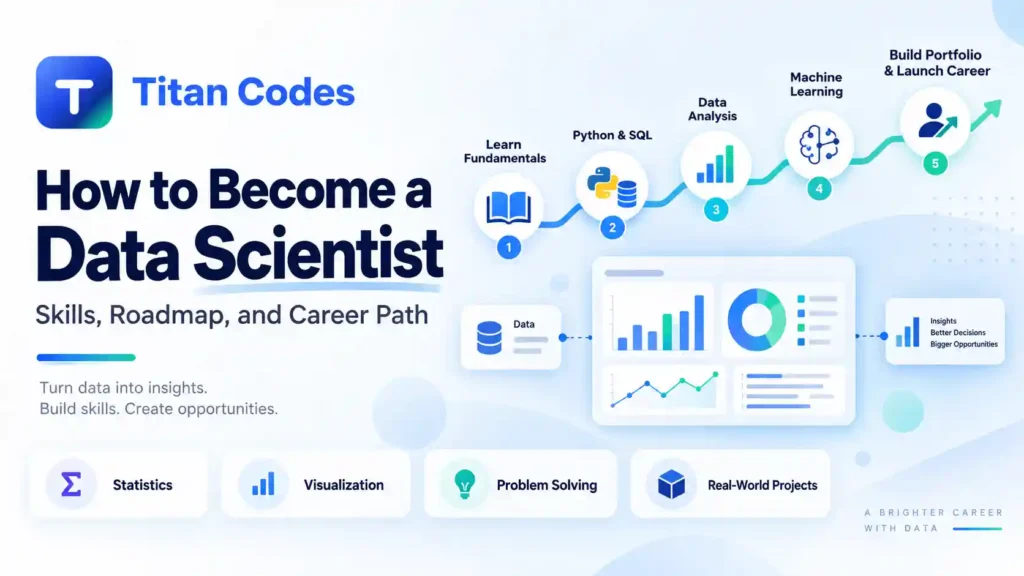
To become a data scientist, start with statistics, Python, SQL, data cleaning, and visualization. Once you are comfortable working with data, learn the basics of machine learning and model evaluation. Then build a few end-to-end projects that show how you solve real problems, create a clear portfolio, and start applying for internships, analyst roles, or entry-level data science positions.
A practical roadmap looks like this:
| Stage | What to Focus On |
| 1 | Understand what data scientists actually do |
| 2 | Learn basic statistics |
| 3 | Learn Python |
| 4 | Learn SQL |
| 5 | Practice cleaning and exploring data |
| 6 | Learn data visualization |
| 7 | Study machine learning fundamentals |
| 8 | Build real projects |
| 9 | Create a portfolio |
| 10 | Apply for practical experience |
If data science itself is still new to you, start with our beginner guide: What Is Data Science?
What Does a Data Scientist Actually Do?
A data scientist works with data to answer questions, find patterns, make predictions, and help people make better decisions.
That may involve writing SQL to pull information from a database in the morning, cleaning a messy dataset in Python after lunch, and explaining the results of a model to a product manager later in the day.
Typical responsibilities include collecting and preparing data, analyzing patterns, creating visualizations, building statistical or machine learning models, testing those models, and explaining what the results mean.
The US Bureau of Labor Statistics also lists duties such as determining which data is useful, collecting and analyzing it, building and testing algorithms and models, using visualization software, and making business recommendations.
The job is not just about building models. A large part of the work is figuring out whether you are solving the right problem in the first place.
Do You Need a Degree to Become a Data Scientist?
A degree is still common in data science hiring.
According to the Bureau of Labor Statistics, data scientists typically need at least a bachelor’s degree in mathematics, statistics, computer science, or a related field. Some employers prefer candidates with a master’s or doctoral degree.
That does not mean everyone working in data science followed the same academic route.
People also move into the field from engineering, economics, finance, physics, biology, marketing analytics, and other backgrounds. In those cases, employers may pay closer attention to technical skills, projects, previous analytical experience, and whether the candidate can explain their work clearly.
Which Degrees Are Useful for Data Science?
Common backgrounds include:
- Computer science
- Statistics
- Mathematics
- Data science
- Economics
- Engineering
- Physics
The degree title is only part of the picture. Someone with a statistics degree who has never worked with Python or SQL may still need considerable practical training before becoming job-ready.
What Skills Do You Need to Become a Data Scientist?
You do not need every skill on day one. These are the areas worth building gradually.
| Skill | Why It Matters |
| Statistics | Helps you understand patterns, variation, and uncertainty |
| Python | Used for data cleaning, analysis, and modeling |
| SQL | Lets you work with data stored in databases |
| Data cleaning | Real business data is rarely ready to analyze |
| Visualization | Helps communicate patterns and results |
| Machine learning | Useful for prediction and classification problems |
| Business knowledge | Helps you solve questions that actually matter |
| Communication | Makes your findings understandable to other teams |
| Git | Helps manage and share project work |
| Cloud basics | Useful when data or models move into production |
Statistics and Mathematics
Start with practical statistics rather than trying to finish an advanced mathematics textbook first.
Useful foundations include:
- Mean, median, and variance
- Probability
- Distributions
- Correlation
- Sampling
- Regression
- Hypothesis testing
You need enough statistics to understand whether a pattern is meaningful and whether the method you are using makes sense.
Python
Python is a good first programming language for data science because it can handle much of the workflow in one ecosystem.
Start with basic Python, then move into:
- NumPy
- Pandas
- Matplotlib
- scikit-learn
Do not spend three months learning every feature of Python before opening a dataset. Once you understand variables, functions, loops, lists, and dictionaries, start using the language for data.
SQL
Do not treat SQL as optional.
A lot of useful company data lives in relational databases, and data scientists regularly need to retrieve it themselves.
Start with:
- SELECT
- WHERE
- GROUP BY
- ORDER BY
- JOIN
- Aggregate functions
Later, you can move into common table expressions, subqueries, and window functions.
Data Visualization and Communication
A technically correct analysis can still fail if nobody understands it.
Learn how to choose charts that answer a question instead of filling a dashboard with visuals.
Just as important, practice explaining what you found in plain language.
Instead of saying:
Feature X has a coefficient of -0.47.
you may need to explain:
Customers who stop using this feature are much more likely to cancel.
Machine Learning Fundamentals
Start with the basics:
- Linear regression
- Logistic regression
- Decision trees
- Classification
- Clustering
- Train/test splits
- Overfitting
- Precision and recall
- Cross-validation
You do not need to begin with neural networks or large language models.
For many entry-level projects, a well-understood simple model is more useful than a complicated model you cannot explain.
Business and Domain Knowledge
This skill gets less attention than Python or machine learning, but it matters enormously.
A data scientist working for an ecommerce business should understand customers, orders, returns, margins, and inventory.
Someone working in SaaS should understand subscriptions, retention, churn, activation, and product usage.
The better you understand the problem, the easier it becomes to decide what data is useful.
Data Scientist Roadmap: What to Learn and in What Order
Here is a practical sequence you can follow.
Step 1: Understand Data Science Fundamentals
Before choosing tools, understand the field.
Learn the difference between data science, data analytics, machine learning, AI, and data engineering.
You should also understand how companies use data for forecasting, customer segmentation, recommendations, fraud detection, and product decisions.
Step 2: Learn Basic Statistics
Learn enough statistics to understand the datasets you are working with.
Focus on concepts you can apply rather than memorizing formulas without context.
A simple dataset can teach you a lot about distributions, outliers, correlation, and sampling.
Step 3: Learn Python for Data Analysis
Once you understand basic Python syntax, start working with Pandas.
Take a CSV file and practice:
- Reading the data
- Selecting columns
- Filtering rows
- Handling missing values
- Grouping records
- Creating new columns
- Combining datasets
That is much closer to real data work than solving dozens of unrelated programming puzzles.
Step 4: Learn SQL
Create or download a small database and start asking questions with SQL.
For example:
Which five products generated the most revenue last month?
Which customers placed more than three orders?
What is the average order value by country?
SQL becomes easier when every query answers a real question.
Step 5: Learn Data Cleaning and Exploratory Analysis
Download a dataset that is not perfectly clean.
Look for:
- Missing values
- Duplicates
- Incorrect formats
- Outliers
- Strange categories
- Relationships between variables
Learning how to investigate a dataset is more valuable than immediately trying to predict something from it.
Step 6: Learn Data Visualization
Take the same dataset and explain what is happening through a few clear charts.
A useful chart should make the answer easier to understand.
Do not add a pie chart, heat map, or dashboard simply because you know how to create one.
Step 7: Learn Machine Learning
Now move into predictive problems.
Start with a simple regression or classification project. Learn how to split data into training and test sets, choose an evaluation metric, compare models, and check for overfitting.
The important question should always be:
Does this model solve the problem well enough to be useful?
Step 8: Build End-to-End Projects
Tutorials usually give you clean data and tell you what model to use.
Real work does not.
An end-to-end project should look more like:
Problem → Data → Cleaning → Exploration → Model → Evaluation → Recommendation
Include the decisions you made along the way.
That is where a portfolio starts becoming interesting.
Step 9: Build Your Portfolio
You do not need 20 projects.
Three strong projects that you understand completely are much better than 20 notebooks copied from tutorials.
For each project, explain:
- What problem you solved
- Where the data came from
- How you cleaned it
- What you discovered
- Why you chose your method
- How you evaluated the result
- What the result means
Step 10: Apply for Real Experience
Do not wait until you know everything.
Look at internships, junior data roles, analytics positions, research opportunities, freelance projects, and data-related work inside your current company.
Your first role does not necessarily need to have “Data Scientist” in the title.
A good analyst role can give you valuable experience with SQL, real business data, dashboards, stakeholders, and messy questions.
Which Data Science Tools Should Beginners Learn?
Beginners often lose time trying to learn too many technologies.
Start with a smaller stack:
| Area | Start With |
| Programming | Python |
| Database queries | SQL |
| Data manipulation | Pandas, NumPy |
| Visualization | Matplotlib |
| Machine learning | scikit-learn |
| Working environment | Jupyter Notebook |
| Version control | Git and GitHub |
| Cloud | Basic AWS, Azure, or Google Cloud concepts |
You can learn Spark, TensorFlow, PyTorch, Docker, Kubernetes, and other tools later if the work requires them.
A job description containing 15 technologies does not mean you need to study all 15 before applying.
What Data Science Projects Should You Build?
Choose projects that demonstrate different skills.
Customer Churn Prediction
Use customer activity or subscription data to predict which users are likely to leave.
This gives you experience with classification, feature preparation, evaluation, and business interpretation.
Sales or Demand Forecasting
Use historical data to estimate future sales or demand.
This is useful for learning time-series analysis and showing how predictions can support inventory or planning.
Customer Segmentation
Group customers according to their behavior.
This can help you practice clustering, exploratory analysis, and explaining groups that do not already have labels.
Product Recommendation System
Build a simple system that recommends products, movies, articles, or other items based on user behavior.
This gives you a chance to work with recommendation logic and think about how a model becomes part of a product.
Build an End-to-End Data Product
This is probably the strongest project once you know the basics.
Instead of stopping at a notebook, expose your model through a simple API or application.
For example:
Dataset → Churn Model → API → Small Dashboard
That shows employers that you understand the difference between building a model and making the result usable.
How to Build a Data Science Portfolio Employers Can Understand
Your portfolio is not only for other data scientists.
A recruiter, hiring manager, or product leader may look at it first.
Make it easy to understand.
Each project should have a clear README that explains the problem before discussing the code.
A good structure is:
The Problem
What did you want to find out?
The Data
Where did the dataset come from?
The Approach
What cleaning, analysis, and modeling did you perform?
The Result
What did you find?
Why It Matters
How could the result be useful in a real setting?
If someone can understand the project without opening your notebook, you are doing it right.
How to Get Data Science Experience Without a Data Scientist Job
This is a common problem for beginners:
Entry-level jobs want experience, but how do I get experience without the job?
Start smaller.
You could work as a data analyst, take an internship, contribute to an open-source project, enter a Kaggle competition, help a nonprofit with data, or solve an analytical problem inside your current role.
Suppose you work in marketing. You might analyze which channels generate the highest-value customers.
If you work in ecommerce, you might study product returns or seasonal demand.
That experience is useful because you are solving a real question rather than following a predefined tutorial.
How to Prepare for a Data Scientist Interview
Interview formats vary, but preparation usually needs to cover more than one area.
Python
Expect questions around data manipulation and basic programming.
Be comfortable reading code and explaining what it does.
SQL
SQL interviews are common because databases are central to many data roles.
Practice joins, grouping, filtering, aggregations, and eventually window functions.
Statistics
Review probability, sampling, hypothesis testing, distributions, correlation, and common statistical mistakes.
Machine Learning
Know how common models work, but spend just as much time understanding evaluation.
Be ready to explain concepts such as:
- Overfitting
- Precision and recall
- Class imbalance
- Feature selection
- Cross-validation
Your Projects
You should be able to explain every major decision in your portfolio.
Interviewers may ask why you chose a model, what failed, what you would change, or whether a simpler method would have worked.
Do not memorize the project description. Understand it.
Business Questions
You may also get open-ended questions such as:
Customer churn increased last month. How would you investigate it?
There may not be one correct answer.
The interviewer wants to see how you turn an unclear business problem into something you can investigate with data.
How Long Does It Take to Become a Data Scientist?
There is no fixed timeline.
Someone who already knows Python, SQL, and statistics will move much faster than someone learning programming for the first time.
A rough learning path might look like this:
| Starting Point | Illustrative Time |
| Analyst or experienced programmer | Several months of focused upskilling |
| Technical graduate | Around 6 to 12+ months |
| Complete beginner | Often 9 to 18+ months |
These are not promises.
Ten hours of focused practice each week for a year is very different from watching an occasional tutorial.
Instead of measuring progress by months, ask whether you can:
- Query data with SQL
- Clean a dataset in Python
- Explain basic statistics
- Explore data independently
- Build and evaluate a simple model
- Complete a project without following every step of a tutorial
- Explain your conclusions clearly
Those are better signals of progress.
Can You Become a Data Scientist Without a Computer Science Background?
Yes.
A computer science background can help, but data science draws people from many fields.
Someone from finance may already understand financial data and business metrics. A biologist may be comfortable with experiments and statistics. A marketer may understand customer behavior.
That domain knowledge can become an advantage.
You will still need the technical fundamentals, particularly Python, SQL, statistics, and working with datasets.
Changing careers does not mean starting from zero. It means adding the skills you are missing to the knowledge you already have.
How Is AI Changing the Data Scientist Role?
AI-assisted tools can now help write Python, generate SQL, explain errors, create documentation, and speed up repetitive work.
That is useful, but it does not remove the need to understand data.
A generated SQL query can still use the wrong table. A model can still leak future information into training data. A beautifully written explanation can still describe a meaningless correlation.
Data scientists still need to judge whether the data is reliable, whether the analysis makes sense, and whether the result answers the original question.
The BLS expects increased adoption of AI-based systems to contribute to demand for data scientists as organizations look for people who can use data and AI to improve decisions, products, and business processes.
AI can help you write a query faster. You still need to know whether it is the right query.
Is Data Science a Good Career?
For people who enjoy working with data, solving problems, and combining technical work with business questions, data science can be an attractive career path.
The current US employment outlook is strong.
The Bureau of Labor Statistics reports a median annual wage of $120,230 for data scientists as of May 2025. Employment is projected to rise from about 275,600 jobs in 2025 to 371,000 in 2035, an increase of roughly 95,400 positions.
That does not mean every new data scientist will earn $120,230.
Salary varies considerably depending on experience, location, industry, education, and the work involved.
The more useful reason to enter the field is that data skills are used across industries, from software and finance to retail, healthcare, logistics, manufacturing, and research.
Common Mistakes When Learning Data Science
One of the biggest mistakes is trying to learn everything.
You do not need Python, R, TensorFlow, PyTorch, Spark, AWS, Azure, Tableau, Power BI, Docker, Kubernetes, and every machine learning algorithm before starting a project.
Other common mistakes include ignoring SQL, jumping into deep learning too early, building only tutorial projects, collecting certificates without practicing, and focusing on model accuracy without understanding whether the result matters.
Another mistake is waiting until you feel completely ready before applying for work.
You probably never will.
Once you have solid fundamentals and a few projects you can explain confidently, start testing the job market. The feedback from real applications will tell you more about what you need to improve.
How Data Science Connects With Real Software Products
A data science project often begins in a notebook, but useful products rarely end there.
Suppose a data scientist builds a model that predicts customer churn.
For employees or customers to use it reliably, the model may eventually need to connect with:
Model → API → Application → Database → Cloud Infrastructure → Monitoring → User Interface
That means production data science often becomes a software engineering problem too.
Recommendation systems, demand forecasts, fraud alerts, customer scoring, search ranking, and personalization all need somewhere to run and a way to deliver their results.
Titan Codes works on the software side of that equation, including custom applications, SaaS products, APIs, and cloud infrastructure.
If you want to see how that infrastructure fits together, explore Titan Codes Cloud Services or our SaaS Development services.
Frequently Asked Questions About Becoming a Data Scientist
-
How Do I Become a Data Scientist From Scratch?
Start with basic statistics, Python, and SQL. Then learn how to clean, explore, and visualize datasets before moving into machine learning. Build several projects that solve real problems, document them clearly in a portfolio, and begin applying for internships, analyst positions, and junior data roles.
-
Can I Become a Data Scientist Without a Degree?
It is possible, but many employers still ask for a bachelor’s degree or higher. Candidates without a related degree may need stronger evidence of their ability through projects, work experience, Python and SQL skills, statistics knowledge, and a strong portfolio.
-
Is Python Enough to Become a Data Scientist?
No. Python is an important tool, but data science also requires SQL, statistics, data cleaning, visualization, problem-solving, and communication. Machine learning becomes important for many roles as you move beyond basic analysis.
-
How Long Does It Take to Become a Data Scientist?
It depends on your starting point and how consistently you study. Someone with analytical or programming experience may need several months of focused learning. A complete beginner may need a year or more to build the technical skills, projects, and confidence required for entry-level work.
-
Do Data Scientists Need to Know Machine Learning?
Many data science roles involve machine learning, so understanding the fundamentals is valuable. However, not every data science problem requires a machine learning model. Statistical analysis, SQL, experimentation, and visualization remain important parts of the job.
-
Can I Become a Data Scientist if I Am Not Good at Math?
You do not need to be a professional mathematician, but you should become comfortable with statistics and quantitative reasoning. Start with probability, distributions, averages, variance, correlation, regression, and hypothesis testing. You can build the mathematics gradually while working with real datasets.
Final Thoughts
Becoming a data scientist is not about finishing the longest possible list of courses.
Learn how to work with data first. Build a solid foundation in statistics, Python, and SQL. Practice cleaning and exploring real datasets. Add machine learning when you understand what problem it is solving, and build projects that you can explain without hiding behind technical jargon.
The tools will change.
The valuable skill is being able to look at a messy problem, find the right data, and turn it into an answer someone can actually use.