
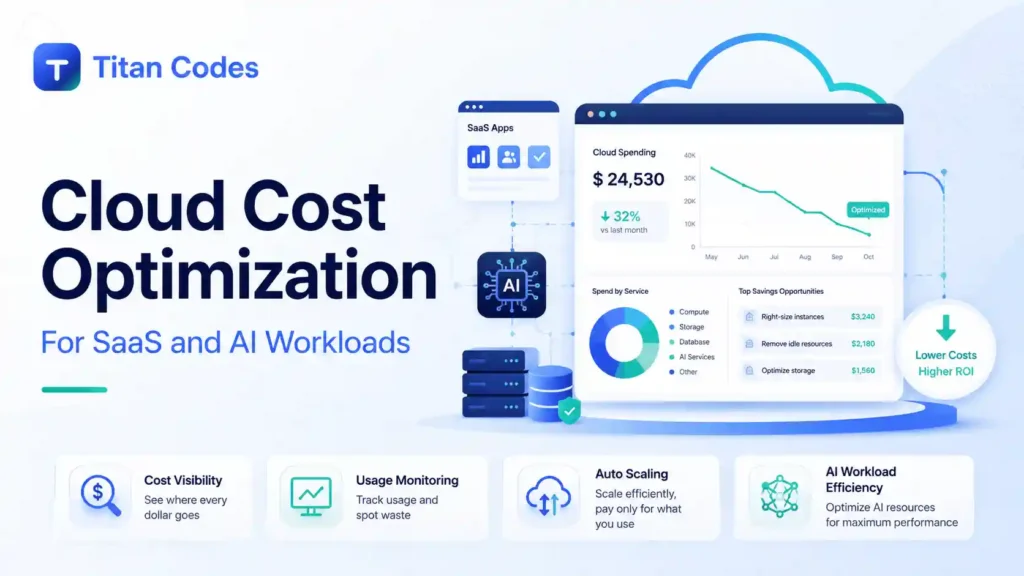
Cloud infrastructure makes it easier to launch products quickly, scale on demand, and add new services without purchasing physical hardware. The same flexibility can also make costs difficult to predict.
A SaaS product may accumulate spend across compute, databases, storage, caching, observability, data transfer, and non-production environments. Add AI, and the cost model becomes even more dynamic. LLM tokens, model APIs, vector search, GPU inference, embeddings, and agent workflows introduce consumption patterns that traditional infrastructure budgets were not designed around.
This is already a significant business problem. Flexera’s 2026 State of the Cloud research found that 85% of respondents identified managing cloud spend as a top cloud challenge, while organizations estimated that 29% of IaaS and PaaS spending was wasted. AI workloads were among the factors contributing to increased cost complexity.
Cloud cost optimization is therefore not simply about paying a smaller bill. It is about making sure infrastructure spend grows in proportion to the business value the product creates.
What Is Cloud Cost Optimization?
Cloud cost optimization is the continuous process of aligning cloud resources, architecture, pricing, and consumption with the performance, reliability, and business value a workload needs.
It is different from simply cutting costs.
IBM describes cloud cost optimization as a combination of strategies, practices, and tools that reduce unnecessary cloud spending while helping organizations run applications cost-effectively and maximize business value.
That distinction matters. Turning off monitoring, removing backups, or reducing database capacity until users experience slow responses may lower the invoice, but it does not make the architecture more efficient.
A better objective is:
Cost + Performance + Reliability + Scalability + Business Value
AWS also treats cost optimization as a tradeoff. Its Well-Architected guidance notes that there are situations where speed to market or shipping an important feature can reasonably matter more than optimizing every infrastructure dollar immediately.
Why Cloud Costs Become Difficult to Control
Most cloud overspending is not caused by one expensive service. It usually develops across multiple parts of the architecture.
| Cost Driver | Common Source of Spend |
| Compute | Oversized VMs, containers, or services running continuously |
| Databases | Excess capacity, expensive queries, unnecessary replicas |
| Storage | Old backups, snapshots, logs, and unused objects |
| Data transfer | Cross-region traffic, APIs, CDN usage, large payloads |
| Kubernetes | Underutilized nodes and poorly sized workloads |
| Observability | Excessive logs, metrics, and trace retention |
| Non-production | Development and staging systems running when unused |
| AI models | Tokens, API calls, inference, embeddings, and repeated reasoning |
| GPU infrastructure | Idle accelerators or poorly matched hardware |
| Vector search | Large indexes, frequent retrieval, and duplicated embeddings |
The problem becomes harder when no one can explain which customer, product feature, environment, or AI workflow produced the spend.
A $20,000 monthly cloud bill is a finance number.
Knowing that one feature generated $7,000 of that bill while producing little customer usage is an optimization insight.
SaaS and AI Workloads Have Different Cost Profiles
Traditional SaaS infrastructure and AI systems share resources, but their economics are not identical.
| SaaS Cost Profile | AI Cost Profile |
| Application compute | Model inference |
| Relational databases | Vector databases and retrieval |
| File and object storage | Embeddings and model artifacts |
| Network traffic | Model-provider and tool API calls |
| Cost per customer | Cost per task, request, or token |
| More predictable baselines | Often highly variable consumption |
| Autoscaling based on traffic | Scaling based on inference demand |
This difference is becoming important enough that FinOps teams are expanding beyond traditional infrastructure management. The 2026 State of FinOps report shows that 98% of respondents now manage AI spend or expect it within their scope, while 90% manage SaaS or plan to do so.
For businesses building both SaaS and AI capabilities, cloud optimization therefore needs to connect infrastructure engineering with product economics.
10 Cloud Cost Optimization Strategies for SaaS and AI Workloads
1. Make Cloud Spend Visible Before Trying to Reduce It
Start with attribution.
Cloud spending should ideally be understandable by service, environment, workload, team, or product. SaaS businesses can go further by calculating cost by customer, tenant, or feature where the architecture makes that practical.
AI systems need another layer of visibility. Track which model, agent, feature, or workflow generates model usage.
For example, if an AI support feature consumes 40% of monthly inference spend, the engineering team should know whether that cost is coming from long prompts, repeated retrieval, unnecessary retries, or simply high customer adoption.
Google Cloud recommends aligning cloud spending with business value and evaluating total cost of ownership rather than looking only at the price of individual resources.
2. Rightsize Compute, Databases, and Containers
Cloud systems are often provisioned around what teams think they might need rather than what they actually use.
Review CPU, memory, database utilization, disk performance, and container requests against real production behavior.
Rightsizing does not mean automatically selecting the smallest instance. It means matching capacity to workload patterns while preserving acceptable response times and reliability.
A database that regularly runs at its limit is not optimized simply because it is inexpensive.
3. Shut Down Idle and Non-Production Resources
Development and staging infrastructure is one of the simplest places to look for waste.
Test servers, abandoned databases, unused storage volumes, temporary environments, and old snapshots can continue generating charges long after their original purpose disappears.
Some non-production workloads can also be scheduled to run only during working hours.
AWS specifically uses development and test environments as an example of workloads that often do not need to operate continuously.
4. Match Scaling to Actual Demand
Autoscaling can reduce the need to provision infrastructure for peak traffic permanently.
Depending on the architecture, this may involve horizontal scaling, serverless execution, scheduled capacity changes, queue-based workers, or scale-to-zero services.
However, serverless is not automatically cheaper.
A service with constant high utilization may be more economical on provisioned infrastructure, while a highly variable background workload may benefit substantially from consumption-based pricing.
The right model depends on traffic shape, execution time, memory, concurrency, and operational requirements.
5. Use Commitment Discounts After You Understand the Baseline
Reserved capacity, Savings Plans, and committed-use discounts can reduce cloud costs for predictable workloads.
The order matters.
Measure → Rightsize → Identify the baseline → Commit
Buying a long-term commitment for an oversized resource can simply lock the business into cheaper waste.
Commitments work best for stable capacity that is likely to remain necessary even as individual services or traffic patterns change.
6. Optimize Storage, Logs, and Data Transfer
Compute often gets the most attention, but secondary cloud services can become expensive at scale.
Review storage lifecycle policies, backup retention, old snapshots, duplicated data, cross-region transfers, API payload sizes, CDN configuration, and observability retention.
Logging deserves particular attention. Keeping every debug event indefinitely in a high-volume production system can create a large bill without providing equivalent operational value.
The goal is not to remove useful observability. It is to retain the data the team actually needs for debugging, reliability, security, and business monitoring.
7. Track SaaS Unit Economics, Not Just the Monthly Bill
A growing cloud bill is not automatically a problem.
If infrastructure spending rises by 20% while paying customer usage increases by 60%, the product may actually be becoming more efficient.
Useful SaaS metrics can include:
| Metric | What It Shows |
| Cost per customer | Infrastructure efficiency by account |
| Cost per active user | Cost of actual adoption |
| Cost per transaction | Operational efficiency |
| Cost per feature | Expensive product capabilities |
| Infrastructure cost as % of revenue | Margin impact |
| Cost per environment | Development and staging overhead |
This is particularly important for a growing SaaS product because architecture, billing, user growth, databases, analytics, and cloud deployment evolve together as the product scales. Titan Codes plans SaaS architecture around practical MVP scope and future growth rather than overbuilding the first release.
8. Optimize AI Model Selection and Token Usage
AI workloads need their own optimization strategy.
One of the easiest mistakes is using the most capable model for every task.
A complex planning workflow may require a frontier model. A simple classification, routing, extraction, or formatting task may not.
The FinOps Foundation recently described this pattern as a new form of over-provisioning. Teams often default to expensive frontier models because they feel safer, even when smaller models can handle the workload effectively.
AI teams should also review unnecessary prompt context, repeated model calls, excessive agent loops, duplicated retrieval, output length, and caching opportunities.
For agentic applications, Titan Codes’ guide to AI agent development cost explains how model selection, tool calls, infrastructure, monitoring, and multi-agent orchestration can affect operating costs.
9. Control GPU and AI Infrastructure Utilization
AI cost optimization is not only about API tokens.
Teams running or fine-tuning models may also pay for GPUs, inference servers, model storage, vector infrastructure, and high-throughput networking.
Key questions include whether GPUs remain idle, whether the hardware matches the inference workload, whether requests can be batched, and whether managed model APIs would be cheaper than operating dedicated infrastructure.
For mixed workloads, a hybrid strategy may be more efficient. Sensitive or predictable workloads could run on dedicated infrastructure while less frequent use cases rely on managed APIs.
10. Make Cost Optimization Continuous With FinOps
Cloud optimization should not happen only after a finance team notices an unusually large invoice.
AWS Cloud Financial Management guidance recommends ownership, cooperation between finance and technology, budgets, forecasts, proactive monitoring, and ongoing cost awareness across the organization.
For a SaaS or AI company, that means engineering, finance, and product teams should periodically review cost alongside customer growth, feature usage, reliability, and revenue.
Optimization becomes an operating discipline rather than a one-time cleanup.
Which Cloud Cost Metrics Should SaaS Teams Track?
The most useful metrics connect infrastructure usage to business outcomes.
| Metric | Why It Matters |
| Monthly cloud spend | Shows overall direction |
| Cost per customer | Measures SaaS unit economics |
| Cost per active user | Connects cost to adoption |
| Cost per request or transaction | Measures workload efficiency |
| Infrastructure cost as % of revenue | Helps evaluate margins |
| AI cost per successful task | Measures actual automation economics |
| Token cost per request | Highlights LLM efficiency |
| GPU utilization | Reveals expensive idle capacity |
| Forecast vs actual spend | Improves budget control |
| Idle resource cost | Creates an optimization backlog |
For AI systems, cost per successful task can be more useful than token cost alone.
A workflow that costs $0.20 but reliably automates a valuable business process may be economically stronger than a $0.05 workflow that fails often and requires manual correction.
Cloud Cost Optimization Example: A Growing AI SaaS Product
Consider a SaaS platform that uses application servers, PostgreSQL, Redis, object storage, a vector database, an LLM API, analytics, and separate staging infrastructure.
As usage grows, the monthly bill starts rising faster than expected.
The engineering team investigates and finds several issues. Staging runs 24 hours a day even though developers use it mainly during business hours. The database was sized for a future traffic level that has not arrived. Logs are retained longer than needed. A premium AI model handles simple classification tasks. Retrieval results are repeatedly regenerated for identical requests.
Rather than cutting capacity indiscriminately, the team addresses each driver.
Staging becomes scheduled. Database capacity is aligned with current utilization and monitored for growth. Logging retention is adjusted. Simple AI tasks are routed to a smaller model. Reusable retrieval results are cached where appropriate. The team also begins tracking AI cost per successful workflow.
The result is not simply a smaller bill. The business can now explain why cloud spend changes and whether higher costs correspond to higher customer usage or value.
What Should You Not Sacrifice to Reduce Cloud Costs?
Cost optimization should never remove the safeguards that keep the product dependable.
Security controls, backups, disaster recovery, critical monitoring, data protection, and required performance still need to meet the risk profile of the application.
A cheaper infrastructure design that creates recurring outages or makes recovery impossible can produce a far higher business cost than the amount saved.
For this reason, Titan Codes’ cloud services are planned around reliability, performance, recovery, monitoring, security basics, and practical scale in addition to cost control.
When Should You Revisit Your Cloud Architecture?
Cloud architecture deserves another review when spending grows significantly faster than users or revenue, database costs dominate the bill, services show consistently low utilization, AI inference becomes unpredictable, or the team cannot explain which products and workloads are generating costs.
The same applies when infrastructure begins limiting product development.
If engineers spend increasing amounts of time manually managing capacity, troubleshooting scaling issues, or working around architecture decisions made for a much smaller product, optimization may require more than tuning a few billing settings.
It may be time to reconsider how the application itself uses the cloud.
How Titan Codes Approaches Cloud Cost Optimization
Titan Codes approaches cloud architecture from the workload outward.
A website, SaaS platform, mobile backend, custom application, and AI agent do not need identical infrastructure. Decisions should reflect application architecture, expected traffic, databases, integrations, recovery requirements, AI consumption, operational risk, and budget.
That means avoiding both extremes: infrastructure that is too fragile for the product and infrastructure that is unnecessarily complex for its current needs.
For AI-powered systems, Titan Codes also considers model usage, approved tools, API calls, monitoring, deployment, and workload behavior as part of the wider architecture. You can explore our AI agent development services for examples of how cloud infrastructure connects with tool use, logging, evaluation, guardrails, and production workflows.
Frequently Asked Questions About Cloud Cost Optimization
What is cloud cost optimization?
Cloud cost optimization is the ongoing process of aligning cloud resources, usage, pricing, and architecture with business requirements. The goal is to reduce unnecessary spend without sacrificing the performance, reliability, security, and scalability the application needs.
What causes high cloud costs?
Common causes include oversized compute, idle resources, excessive database capacity, unnecessary storage, long log retention, cross-region data transfer, unused non-production environments, and poor cost visibility. AI applications can also accumulate costs through excessive model calls, tokens, GPUs, embeddings, and agent loops.
How can SaaS companies reduce cloud costs?
SaaS teams can reduce waste by improving cost attribution, rightsizing infrastructure, autoscaling appropriate workloads, scheduling non-production environments, optimizing storage and data transfer, and tracking unit economics such as cost per customer or transaction.
How can businesses optimize AI cloud costs?
AI cost optimization can include selecting models based on task complexity, reducing unnecessary context, limiting repeated model calls, caching reusable results, improving GPU utilization, and measuring cost per successful AI task rather than looking only at token prices.
Final Thoughts
Cloud cost optimization works best when businesses stop treating the cloud bill as an isolated infrastructure expense.
For SaaS products, the useful question is whether cloud cost per customer, transaction, or feature is improving as the product grows. For AI systems, the focus should extend to cost per successful task, model selection, inference efficiency, and the value produced by automation.
The goal is not to build the cheapest possible infrastructure.
It is to build cloud architecture that delivers the required performance, reliability, and business value without paying for capacity or complexity the product does not need.