
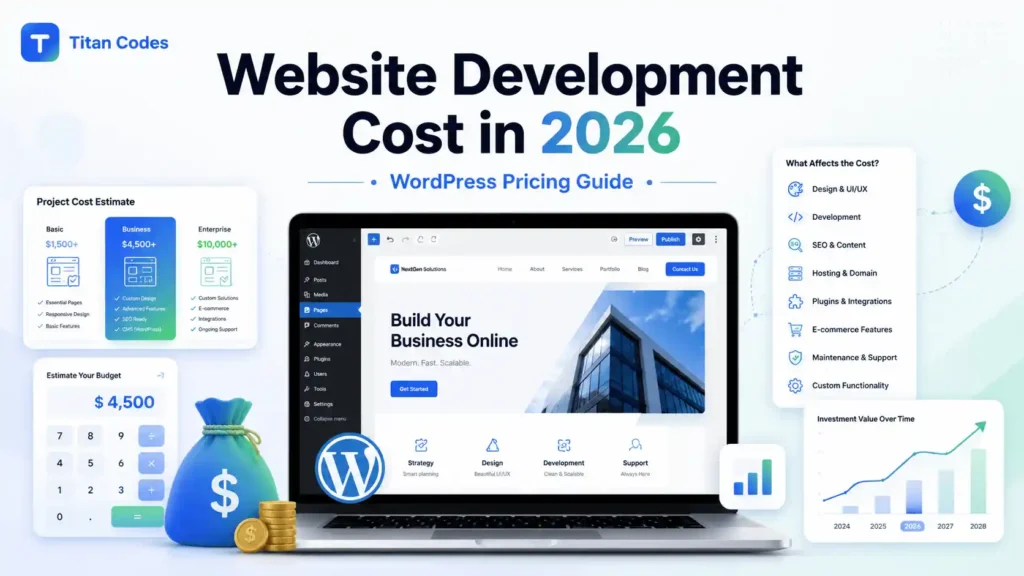
Quick Answer: How Much Does Website Development Cost in 2026?
Website development cost in 2026 can range from $1,000 to $500,000+, depending on what you are building. A simple business website may cost between $3,000 and $15,000, while a custom ecommerce store can range from $20,000 to $250,000+. SaaS platforms, marketplaces, and AI-powered web applications can cost anywhere from $50,000 to $500,000+ based on features, integrations, security, and scalability.
A 2026 GoodFirms survey of 300+ web development companies across 31 countries found that fixed-price website projects range from $1,000 to $150,000+, with 63% of agencies quoting between $1,000 and $15,000. The same survey also found that 98% of agencies now use AI in their development workflow, but complex websites have not necessarily become cheaper because client expectations have increased.
The simple truth is this: a website is no longer just a digital brochure. In 2026, your website is often your sales engine, lead generation system, customer support channel, analytics hub, and brand experience. That is why website development pricing varies so widely.
At Titan Codes, we work with businesses that need more than just pages. We help companies build websites, custom software, and AI-powered platforms that are designed to support real business growth.
Website Development Cost Snapshot in 2026
| Website Type | Estimated Cost in 2026 |
| Landing Page | $500 – $3,000 |
| Portfolio Website | $1,000 – $5,000 |
| Small Business Website | $3,000 – $15,000 |
| CMS Website | $5,000 – $25,000 |
| Corporate Website | $15,000 – $75,000 |
| Ecommerce Website | $20,000 – $250,000+ |
| Marketplace Platform | $80,000 – $400,000+ |
| SaaS Platform | $50,000 – $500,000+ |
| AI-Powered Web Platform | $100,000 – $600,000+ |
| Enterprise Website | $120,000 – $500,000+ |
These are realistic market ranges, not fixed prices. The final cost depends on design complexity, number of pages, frontend and backend development, third-party integrations, CMS choice, security requirements, cloud infrastructure, and long-term maintenance.
Why Website Development Costs Vary So Much
Two businesses can ask for a “business website” and receive completely different quotes. One may need a simple 5-page website with a contact form. Another may need a custom dashboard, CRM integration, payment system, AI chatbot, analytics, multilingual pages, and high-speed cloud hosting.
That is why website development cost is usually shaped by five major factors:
- Website size
- Design complexity
- Features and functionality
- Technology stack
- Development team location and expertise
A basic website can be built quickly using templates and a CMS. A custom platform needs discovery, UI/UX planning, frontend engineering, backend development, database design, APIs, QA testing, security, and ongoing optimization.
Website Cost by Complexity Level
1. Basic Website Cost: $1,000 to $15,000
A basic website is usually best for freelancers, consultants, local service providers, early startups, restaurants, small agencies, and personal brands.
A basic website usually includes:
- 5 to 10 pages
- Home, About, Services, Contact, Blog
- Mobile responsive design
- Contact form
- Basic SEO setup
- CMS integration
- Google Analytics setup
- Basic speed optimization
A template-based basic website can cost around $1,000 to $5,000. A more polished small business website with custom branding, better content structure, and conversion tracking can cost $8,000 to $15,000.
2. Medium Business Website Cost: $15,000 to $75,000
A medium-complexity website is ideal for growing businesses that need better branding, lead generation, SEO, content management, and integrations.
A medium website may include:
- 10 to 50 pages
- Custom UI/UX design
- Blog or resource center
- CMS setup
- CRM integration
- Booking or inquiry system
- Technical SEO
- Conversion tracking
- Performance optimization
- Advanced forms
- Security setup
This type of website usually costs between $15,000 and $75,000, depending on the number of pages, custom design depth, integrations, and content requirements.
3. Complex Website Cost: $75,000 to $500,000+
A complex website is closer to a digital product than a standard website. It may include user accounts, dashboards, workflows, payments, automation, AI features, and enterprise-level security.
A complex website may include:
- Custom backend
- User authentication
- Admin panel
- User dashboard
- API integrations
- Payment gateway
- Database architecture
- Cloud deployment
- AI-powered features
- Multi-role permissions
- Advanced reporting
- Security and compliance
Complex websites usually cost between $75,000 and $500,000+. Enterprise-grade platforms can go even higher if they require high traffic handling, compliance, custom infrastructure, or advanced AI.
Website Development Cost by Type
Small Business Website Cost: $3,000 to $15,000
A small business website is designed to build credibility, explain services, generate inquiries, and support local or niche SEO.
Typical features include:
- Homepage
- Service pages
- About page
- Contact form
- Testimonials
- Blog
- Basic SEO
- CMS setup
- Mobile responsive design
Small business websites usually cost $3,000 to $8,000 with a freelancer or template-based setup. A boutique agency or custom design partner may charge $8,000 to $15,000.
Corporate Website Cost: $15,000 to $75,000
Corporate websites need stronger branding, better page architecture, professional content structure, and conversion-focused design.
Typical features include:
- Custom UI/UX
- Multiple service pages
- Case studies
- Blog or insights section
- Careers page
- Investor or media page
- CRM integration
- Analytics and tracking
- SEO-ready structure
- Performance optimization
Corporate website development usually costs $15,000 to $75,000.
Ecommerce Website Cost: $20,000 to $250,000+
Ecommerce website cost depends on product catalog size, checkout complexity, payment gateway, shipping logic, inventory system, and integrations.
| Ecommerce Type | Estimated Cost |
| Starter Shopify or WooCommerce Store | $5,000 – $25,000 |
| Custom Ecommerce Website | $20,000 – $80,000 |
| Shopify Plus or Advanced WooCommerce | $25,000 – $120,000 |
| Headless Ecommerce | $90,000 – $250,000+ |
| Enterprise Ecommerce | $250,000+ |
Ecommerce features that increase cost include:
- Product catalog
- Cart and checkout
- Payment gateway
- Inventory management
- Shipping integration
- Tax calculation
- Customer accounts
- Subscription billing
- Multi-currency support
- ERP integration
- Product configurators
- AI recommendations
A simple ecommerce website may be affordable, but a high-performance ecommerce platform needs strong architecture, security, and ongoing optimization.
SaaS Website and Web App Cost: $50,000 to $500,000+
A SaaS website is not just a marketing site. It is a software product that users log into, pay for, and use regularly.
A SaaS platform may include:
- User registration
- Login and authentication
- Subscription billing
- User dashboard
- Admin dashboard
- Role-based permissions
- API integrations
- Product analytics
- Notifications
- Reports
- Security controls
- Cloud hosting
- QA automation
A SaaS MVP may start around $50,000 to $120,000. A production-ready SaaS platform can cost $150,000 to $500,000+. Enterprise SaaS products with compliance, SSO, advanced reporting, and AI features can exceed $1 million.
Marketplace Website Cost: $80,000 to $400,000+
A marketplace connects two or more user groups, such as buyers and sellers, clients and service providers, or vendors and customers.
Marketplace features may include:
- Buyer accounts
- Seller accounts
- Vendor dashboard
- Product or service listings
- Search and filters
- Reviews and ratings
- Payment processing
- Commission logic
- Dispute management
- Messaging system
- Admin moderation
- Analytics dashboard
Marketplace development usually costs $80,000 to $400,000+ because it includes complex workflows, multiple user roles, payments, and trust-building features.
AI-Powered Website or Platform Cost: $100,000 to $600,000+
AI is one of the biggest cost drivers in 2026. AI can reduce some development time, but building real AI features into a website requires careful planning, data handling, model selection, testing, and cost control.
AI features may include:
- AI chatbot
- AI search
- AI content recommendations
- AI product recommendations
- AI workflow automation
- AI customer support assistant
- AI analytics dashboard
- AI document processing
- AI personalization engine
| AI Feature | Estimated Cost |
| AI Chatbot | $5,000 – $25,000 |
| AI Smart Search | $10,000 – $40,000 |
| AI Recommendation Engine | $8,000 – $30,000 |
| AI Workflow Automation | $10,000 – $50,000 |
| Custom AI Web App | $100,000 – $600,000+ |
AI-powered websites also come with ongoing costs, including API usage, cloud compute, model monitoring, data storage, security reviews, and prompt optimization.
Feature-Wise Website Development Cost Breakdown
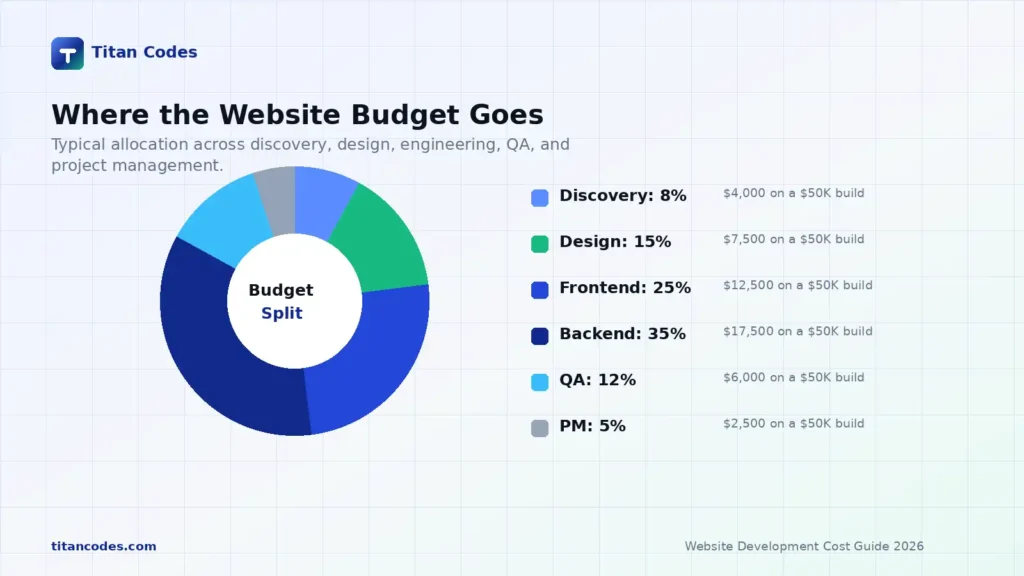
| Feature | Estimated Cost |
| UX Research and Strategy | $2,000 – $10,000 |
| Custom UI Design | $3,000 – $15,000 |
| Frontend Development | $5,000 – $25,000 |
| Backend Development | $10,000 – $50,000+ |
| CMS Integration | $2,000 – $10,000 |
| User Login and Authentication | $2,000 – $8,000 |
| User Dashboard | $5,000 – $25,000 |
| Payment Gateway Integration | $3,000 – $12,000 |
| CRM Integration | $3,000 – $15,000 |
| API Integrations | $3,000 – $20,000 |
| Ecommerce Product System | $8,000 – $40,000 |
| Search and Filters | $2,000 – $10,000 |
| Analytics and Reporting | $3,000 – $12,000 |
| Security Features | $4,000 – $25,000 |
| Performance Optimization | $2,000 – $10,000 |
| Accessibility Improvements | $5,000 – $18,000 |
| QA and Testing | $2,000 – $15,000 |
A website quote becomes easier to understand when it is broken down by features. If your project includes dashboards, payments, APIs, AI, and custom backend logic, the cost will naturally be much higher than a simple informational website.
CMS Website vs Custom Website Cost
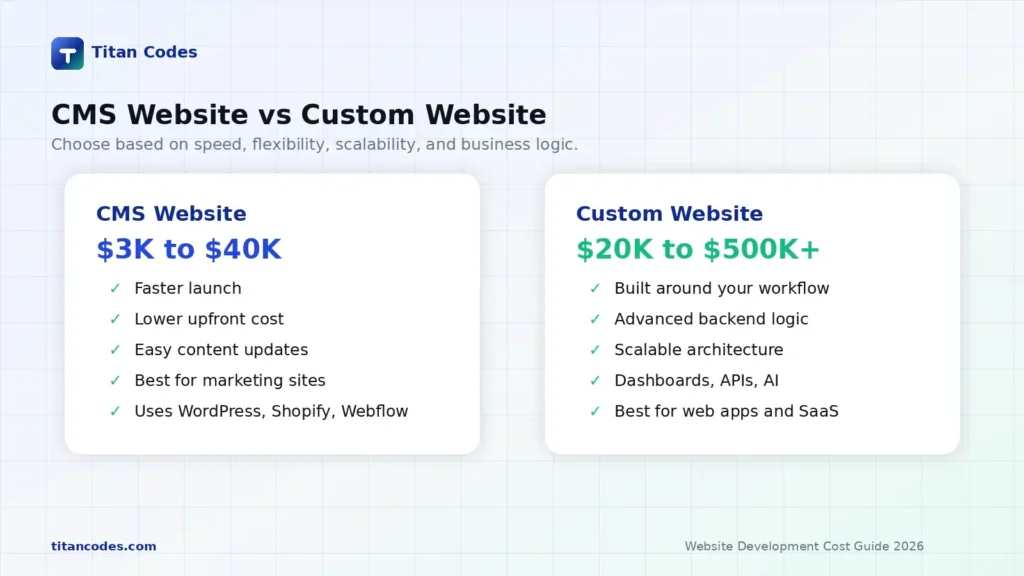
One of the biggest decisions you will make is whether to use a CMS or build a fully custom website.
CMS Website Cost: $3,000 to $40,000
CMS websites are ideal for businesses that need content control without building everything from scratch.
Popular CMS platforms include:
WordPress remains one of the most widely used CMS platforms. W3Techs reported on July 5, 2026, that WordPress is used by 59.2% of websites whose CMS is known and 41.5% of all websites.
A CMS website is usually cheaper because it uses existing tools, themes, plugins, and content workflows. However, costs increase when you need custom plugins, complex integrations, performance tuning, multilingual setup, or advanced editorial workflows.
Custom Website Cost: $20,000 to $500,000+
A custom website is built around your specific business logic, workflows, and growth requirements.
Custom development is best when you need:
- Unique user experience
- Custom backend
- Business-specific workflows
- API integrations
- Scalable architecture
- SaaS features
- AI features
- Enterprise security
- Advanced reporting
- Custom dashboards
A custom website costs more upfront, but it gives you more flexibility, better scalability, and stronger long-term control.
Website Development Cost in the USA vs India
| Region | Typical Hourly Rate |
| USA | $50 – $150+ |
| UK and Western Europe | $50 – $120+ |
| Eastern Europe | $35 – $80 |
| India | $10 – $40 |
| Southeast Asia | $15 – $50 |
| Latin America | $30 – $90 |
USA-based agencies usually charge more because of higher labor costs, senior talent availability, and local operating expenses. India-based development teams can offer more cost-effective pricing, but the quality depends heavily on experience, communication, project management, QA, and technical leadership.
The lowest hourly rate is not always the best deal. A senior developer at a higher rate may complete a feature faster and with fewer bugs than a cheaper developer who needs more supervision and rework.
How AI Is Changing Website Development Cost in 2026
AI has changed how websites are planned, designed, coded, tested, and optimized. Developers now use AI tools for code generation, debugging, content structuring, testing support, documentation, and prototyping.
But AI has not made all websites cheaper.
For simple websites, AI can reduce time and cost. For complex websites, the cost often stays the same or increases because clients now expect better design, faster performance, personalization, automation, and analytics.
The GoodFirms 2026 survey found that 98% of surveyed agencies use AI, but agencies still price complex projects based on business value, technical responsibility, and architecture, not just coding hours.
In simple terms, AI helps teams move faster. It does not replace strategy, architecture, security, UX, QA, or accountability.
Website Maintenance Cost in 2026
Many businesses plan only for the initial website build. That is a mistake. A website needs ongoing maintenance to stay secure, fast, accurate, and competitive.
Website maintenance may include:
- Hosting
- Domain renewal
- SSL certificate
- CMS updates
- Plugin updates
- Security patches
- Bug fixes
- Backups
- Uptime monitoring
- Content updates
- Speed optimization
- Analytics review
- SEO improvements
- Accessibility updates
| Website Type | Annual Maintenance Cost |
| Small Business Website | $1,000 – $6,000 |
| CMS Website | $2,000 – $12,000 |
| Corporate Website | $6,000 – $24,000 |
| Ecommerce Website | $10,000 – $50,000 |
| SaaS or Web App | $25,000 – $150,000+ |
| Enterprise Platform | $50,000 – $300,000+ |
A professional website can cost 150% to 300% of the initial build cost over a 2 to 3 year period when hosting, maintenance, integrations, content, SEO, security, and feature improvements are included.
Hidden Website Development Costs Most Businesses Forget
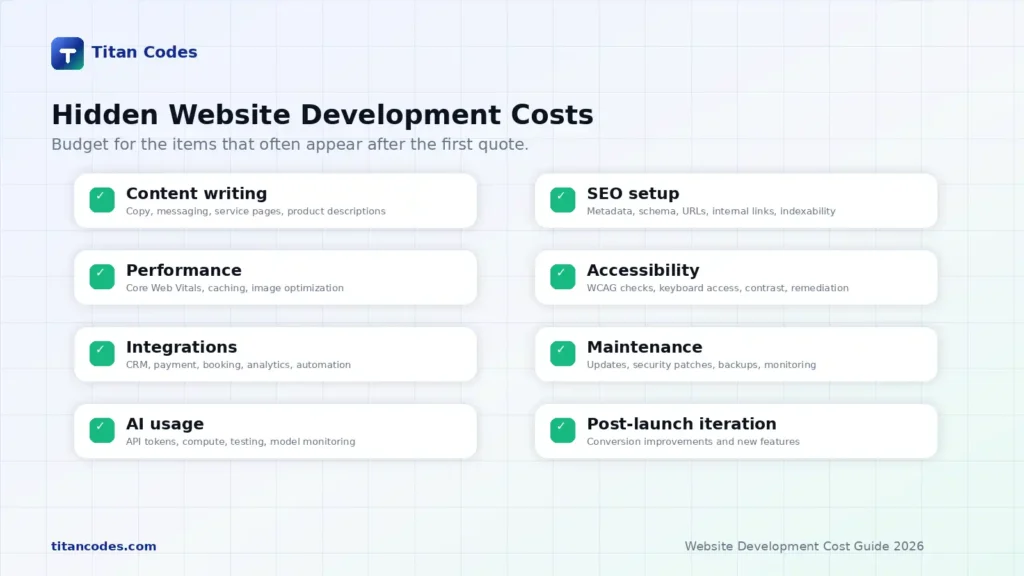
Hidden costs are one of the biggest reasons website projects go over budget. These costs are not always included in the first quote.
Common hidden costs include:
1. Content Writing
Your website needs clear, persuasive content. If your team does not provide copy on time, the project can slow down.
2. Photography and Visual Assets
Custom images, product photos, team photos, icons, and videos can improve trust and conversion, but they add cost.
3. SEO Setup
Technical SEO should not be treated as an afterthought. URL structure, metadata, schema, internal linking, page speed, and indexability should be planned during development.
4. Performance Optimization
Google’s Core Web Vitals focus on loading, interactivity, and visual stability. Google recommends LCP within 2.5 seconds, INP of 200 milliseconds or less, and CLS of 0.1 or less for a good user experience.
5. Accessibility
Accessibility is becoming a standard requirement for professional websites. The W3C recommends using the most current version of WCAG when developing or updating accessibility policies, and WCAG 2.2 is the current recommendation.
6. Third-Party Tools
CRM software, email marketing tools, booking tools, payment gateways, analytics platforms, and AI APIs can all add monthly or yearly costs.
7. Post-Launch Improvements
A website is never truly finished. Once real users visit the site, you may need to improve pages, fix UX issues, update CTAs, add content, or optimize conversions.
Website Development Timeline in 2026
| Website Type | Typical Timeline |
| Landing Page | 1 – 3 weeks |
| Basic Website | 2 – 6 weeks |
| Small Business Website | 4 – 8 weeks |
| Corporate Website | 8 – 16 weeks |
| Ecommerce Website | 8 – 24 weeks |
| SaaS MVP | 10 – 20 weeks |
| Marketplace Platform | 4 – 8 months |
| Enterprise Website | 6 – 12 months |
| AI-Powered Platform | 6 – 12 months |
Timelines depend on scope clarity, content readiness, design approval, development complexity, integrations, testing, and client feedback speed.
Freelancer vs Agency vs In-House Team
Hiring a Freelancer
Freelancers are best for small websites, landing pages, simple CMS builds, and limited budgets.
Best for: Projects under $15,000
Pros: Lower cost, flexible, direct communication
Cons: Limited capacity, higher dependency risk, less QA and project management
Hiring an Agency
Agencies are best for businesses that need strategy, design, development, testing, and support under one team.
Best for: Projects from $15,000 to $250,000+
Pros: Full team, better process, QA, accountability, scalability
Cons: Higher cost than freelancers
Building an In-House Team
An in-house team is best when website and software development are ongoing business functions.
Best for: Continuous product development
Pros: Full control, deep business understanding
Cons: High fixed cost, hiring complexity, management overhead
For most growing businesses, an agency offers the best balance of expertise, speed, accountability, and long-term support.
How to Reduce Website Development Cost Without Hurting Quality
You do not always need to build everything at once. Smart planning can reduce cost while still protecting quality.
Here are practical ways to control your budget:
- Start with an MVP
- Define your scope clearly
- Prioritize must-have features
- Use a CMS when custom development is not required
- Avoid unnecessary animations and complex effects
- Prepare content before development starts
- Choose scalable technology
- Use reusable components
- Keep revision rounds controlled
- Plan integrations early
- Add AI features in phases
- Budget for maintenance from day one
The goal is not to build the cheapest website. The goal is to build the right website for your business stage.
Suggested Website Budget by Business Stage
| Business Stage | Recommended Budget |
| New Startup | $3,000 – $15,000 |
| Local Small Business | $5,000 – $20,000 |
| Growing Service Business | $15,000 – $50,000 |
| Ecommerce Brand | $20,000 – $150,000 |
| SaaS Startup | $50,000 – $250,000 |
| Enterprise Company | $120,000 – $500,000+ |
| AI Product Company | $100,000 – $600,000+ |
A startup may not need a complex custom platform on day one. A growing company may need more than a template. An enterprise may need security, scalability, compliance, and integrations from the beginning.
How Titan Codes Can Help
At Titan Codes, we build websites, custom software, and AI-powered platforms for businesses that want scalable digital solutions.
We can help you with:
- Website development
- Custom software development
- Ecommerce development
- SaaS platform development
- AI development
- Web app development
- UI/UX design
- CMS development
- API integrations
- Website maintenance
- Performance optimization
Whether you need a small business website, ecommerce store, SaaS MVP, marketplace, or AI-powered platform, our team can help you estimate the right cost, timeline, and technology stack before development begins.
Final Thoughts
Website development cost in 2026 depends on what your business actually needs. A simple website can cost a few thousand dollars, while a custom ecommerce, SaaS, marketplace, or AI-powered platform can require a six-figure investment.
If your goal is only to have an online presence, a CMS website may be enough. If your website needs to support sales, operations, automation, customer accounts, payments, or AI features, custom development is usually the better long-term choice.
The best approach is to define your goals, list your required features, understand your timeline, and plan for both initial development and ongoing maintenance.
A good website is not just an expense. It is a business asset that can generate leads, increase trust, improve customer experience, and support growth for years.
FAQs About Website Development Cost in 2026
-
How much does it cost to build a website in 2026?
Website development cost in 2026 can range from $1,000 to $500,000+. A small business website may cost $3,000 to $15,000, while ecommerce, SaaS, marketplace, and AI-powered platforms can cost much more.
-
How much does a small business website cost?
A small business website usually costs between $3,000 and $15,000, depending on design, number of pages, CMS setup, SEO, and integrations.
-
How much does an ecommerce website cost?
An ecommerce website can cost between $20,000 and $250,000+. Simple Shopify or WooCommerce stores cost less, while headless or enterprise ecommerce platforms cost more.
-
How much does a custom website cost?
A custom website usually costs between $20,000 and $500,000+, depending on features, backend logic, integrations, dashboards, security, and scalability.
-
Is WordPress cheaper than custom development?
Yes, WordPress is usually cheaper than custom development because it uses existing themes, plugins, and CMS tools. However, advanced WordPress websites with custom plugins, integrations, and performance optimization can still become expensive.