
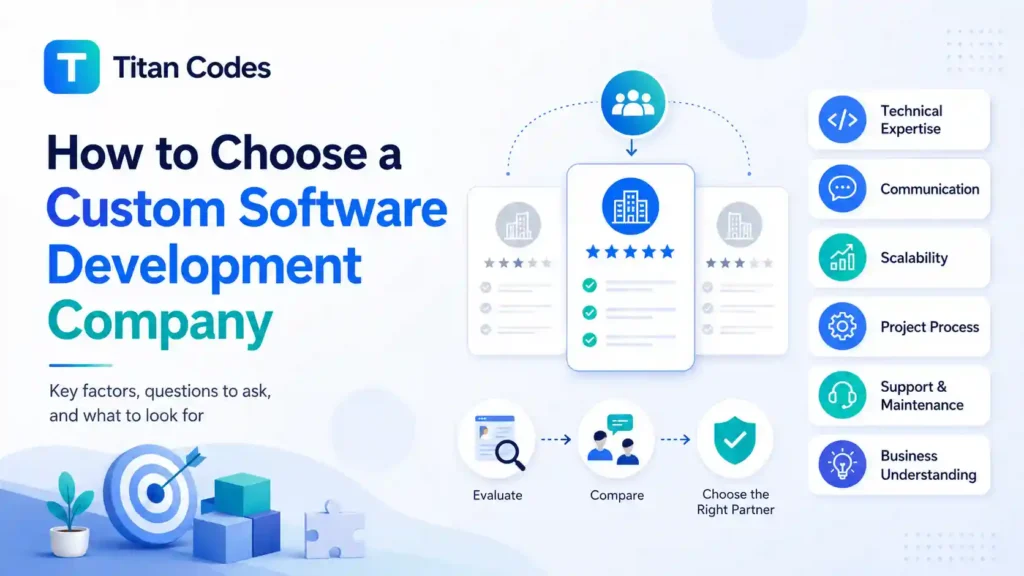
Choosing a custom software development company is a decision that can affect your business long after the first version of the software launches. The right partner can turn complex workflows into a reliable digital product. The wrong one can leave you with missed deadlines, difficult-to-maintain code, unclear ownership, and a system that becomes expensive to change.
Project complexity makes the decision even more important. According to PMI’s 2026 Pulse of the Profession report, four out of five projects experience some form of negative outcome when complexity is poorly managed. Changing requirements, stakeholder disagreements, integration challenges, and shifting priorities are among the issues project teams regularly face.
So, how do you choose a custom software development company?
Look beyond the portfolio and hourly rate. Evaluate how the company understands your business problem, plans architecture, communicates, protects ownership, tests software, handles security, supports search visibility, and prepares the product for future growth.
Here are the factors that matter most.
Start by Defining What You Need From a Software Development Company
Before comparing development companies, get clear about the problem you want the software to solve.
You do not need a complete technical specification. In fact, a capable development partner should help turn business requirements into a realistic technical plan.
Start with:
- The business problem you want to solve
- Who will use the software
- The most important workflows
- Existing systems that may need integration
- Essential features
- Desired launch timeline
- Budget expectations
- Security or compliance requirements
- What success should look like after launch
For example, “We need a React application” describes a technology preference. “We need a customer portal that reduces manual order processing and connects with our CRM” describes a business requirement.
Technology decisions should follow the problem, not the other way around.
If your business has outgrown spreadsheets, disconnected systems, or generic platforms, understanding how custom software development works can also help you determine what should be custom-built and what can remain off the shelf.
10 Things to Evaluate When Choosing a Custom Software Development Company
1. Relevant Experience, Not Just a Large Portfolio
A polished portfolio is useful, but the number of projects a company displays tells you very little about whether it can handle yours.
Look for experience with similar technical or business complexity.
If you are building a SaaS platform, for example, experience with authentication, subscriptions, dashboards, permissions, APIs, and admin workflows can matter more than whether the company has previously served your exact industry.
Ask potential partners to explain:
- What problem they solved
- What technical challenges they encountered
- Which integrations were involved
- How requirements changed
- What happened after launch
You are evaluating how the team thinks, not just what its screenshots look like.
2. A Structured Discovery and Requirements Process
Be cautious when a development company recommends a detailed solution before properly understanding your requirements.
Good discovery should examine users, workflows, data, integrations, constraints, priorities, risks, and expected outcomes before full development begins.
The result should be enough clarity to answer questions such as:
- What are we building first?
- What can wait?
- Which technical dependencies exist?
- What are the biggest risks?
- How will we know a feature is complete?
At Titan Codes, our development process starts with strategy and architecture before moving into design and engineering. This helps connect project scope, technology choices, testing, and launch requirements rather than treating them as separate activities.
3. Technical Expertise and Architecture Judgment
Do not select a company simply because its website lists dozens of programming languages and frameworks.
A strong engineering team should be able to explain why a particular technology is appropriate for your project.
The conversation should cover areas such as:
- Frontend and backend architecture
- Database design
- APIs and integrations
- Authentication and permissions
- Hosting and cloud infrastructure
- Performance requirements
- Maintainability
- Expected scale
The newest framework is not automatically the right choice. A good architecture balances current requirements with realistic future needs without overengineering the first release.
That matters because poor technical decisions accumulate. In the 2024 Stack Overflow Developer Survey, 63% of professional developers identified technical debt as their top workplace frustration.
Ask how the team approaches maintainability, code reviews, documentation, testing, and future feature development.
4. Clear Communication and Project Transparency
Software projects involve hundreds of decisions. You should understand how those decisions will be communicated before signing a contract.
Ask:
- Who will be your main point of contact?
- How often will progress be reviewed?
- Will you see working software during development?
- How are delays or risks communicated?
- Where are requirements and decisions documented?
- What happens when the scope changes?
A development company should be able to explain technical issues in language business stakeholders can understand.
Constant meetings are not the goal. Visibility is.
You should know what is being built, what has been completed, what decisions are pending, and what could affect the timeline.
5. Source Code and Intellectual Property Ownership
Ownership should never be an assumption.
Before development starts, clarify who controls:
- Source code
- Git repositories
- Design files
- Hosting accounts
- Cloud infrastructure
- Domains
- Databases
- Analytics accounts
- Third-party integrations
- Technical documentation
The contract should also clearly address intellectual property rights.
A custom product may become an important business asset. You should not discover after launch that moving to another developer requires rebuilding access, transferring critical accounts, or negotiating ownership of software you believed was already yours.
This is one reason client ownership is part of the Titan Codes development approach. Code, hosting access, assets, documentation, and handover should be considered from the beginning, not only when a project ends.
6. Testing and Quality Assurance
Ask exactly what “testing” means in the proposal.
Depending on the product, quality assurance may need to cover:
- Functional testing
- Mobile and responsive behavior
- Browser compatibility
- API and integration testing
- Form validation
- Authentication and permissions
- Regression testing
- Performance
- Analytics and tracking
- Deployment checks
Testing should be part of development rather than something squeezed into the final few days before launch.
You should also understand how defects are reported, prioritized, fixed, and retested.
7. Security Practices
Security should be discussed during architecture and development, not added as a final checklist before deployment.
The appropriate controls depend on the product, but a software development company should be able to discuss areas such as authentication, authorization, sensitive data, API security, dependency management, environment access, secrets, logging, and deployment configuration.
The OWASP Top 10:2025 identifies major web application risks including broken access control, security misconfiguration, software supply chain failures, cryptographic failures, injection, and insecure design.
You do not need every vendor to turn the sales call into a security audit. You do need confidence that security is part of how the team designs and builds software.
8. Technical SEO and AI Search Readiness
This criterion is particularly important if the software includes a public-facing website, SaaS marketing site, ecommerce experience, marketplace, directory, or content platform.
SEO problems are often created during development.
Your development company should understand technical considerations such as:
- Crawlability and indexability
- Clean URL architecture
- Canonicalization
- XML sitemaps
- Robots directives
- Internal linking
- Semantic HTML
- Structured data implementation
- Metadata
- Mobile experience
- Page performance
- JavaScript rendering
- Redirects
These foundations are becoming more important, not less, as discovery expands into AI-powered search.
Google’s current guidance for generative AI features in Search explicitly states that existing SEO best practices remain relevant. Google also says that its AI systems rely on the same core processes used to find, crawl, understand, and index web content, and recommends maintaining a clear technical structure and crawlable content.
Technical SEO alone does not guarantee visibility in AI Overviews, answer engines, generative search, or LLM responses. Strong content, entity clarity, authority, original expertise, citations, and brand mentions also matter.
However, a technically inaccessible or poorly structured platform can undermine those efforts before the content strategy even begins.
For public-facing products, ask whether the development team considers SEO, AEO, GEO, and AI-search discoverability during architecture, rather than expecting an SEO team to repair structural problems after launch.
9. Scalability, Maintainability, and Post-Launch Support
“Scalable” should not automatically mean designing every application for millions of simultaneous users.
Practical scalability also means being able to add:
- New features
- More user roles
- Additional integrations
- New locations or markets
- Larger datasets
- New workflows
- Automation
- Reporting requirements
Ask how the architecture can evolve if the business changes.
Also establish what happens after launch. Will you receive documentation, credentials, deployment information, knowledge transfer, bug support, and options for future development?
For SaaS projects in particular, launch is normally the beginning of the learning process rather than the end. Our guide to the SaaS development timeline from MVP to launch explains how scope, integrations, QA, feedback, and iteration affect the path from an initial product to a stable release.
10. Pricing and Engagement Model
Price matters, but comparing proposals only by their headline figure can be misleading.
Common engagement models include:
- Fixed-price projects
- Time and materials
- Milestone-based delivery
- Dedicated or extended teams
The right model depends on how clearly requirements are known and how likely they are to change.
Compare what each estimate actually includes. One proposal may include discovery, architecture, UX, QA, deployment, documentation, and project management, while another quotes development alone.
Also ask how scope changes are priced.
The goal is not necessarily to choose the highest or lowest proposal. It is to understand what you are buying, what assumptions the estimate depends on, and what could change the final cost.
Red Flags to Watch for Before Hiring a Software Development Company
Certain warning signs deserve closer examination:
- Providing a detailed estimate without understanding the project
- Promising an unrealistic timeline simply to win the contract
- Recommending a technology stack before discussing the business problem
- Being unclear about source code ownership
- Refusing reasonable access to repositories or infrastructure
- Having no defined QA process
- Giving vague answers about who will actually work on the project
- Being unable to explain how scope changes are managed
- Treating security as someone else’s responsibility
- Ignoring technical SEO on public-facing platforms
- Offering no clear handover or post-launch process
One red flag does not automatically disqualify a company. Several together usually indicate that more due diligence is needed.
Questions to Ask a Custom Software Development Company
Before making a final decision, ask each shortlisted company the same core questions:
- Have you handled projects with similar technical complexity?
- How do you discover and validate requirements?
- Who will actually work on our project?
- How will progress and risks be communicated?
- Why would you recommend this architecture or technology stack?
- Who owns the source code, repositories, accounts, and infrastructure?
- What testing and QA are included?
- How do you approach application security?
- For public-facing products, how do you handle technical SEO and search visibility?
- What happens after the software launches?
- How are scope changes and additional costs handled?
- How will another development team take over the product if required?
Pay attention not only to the answers, but also to whether the company is willing to discuss tradeoffs.
A credible development partner should be comfortable saying, “That depends, and here is what we need to understand before deciding.”
Why Businesses Choose Titan Codes for Custom Software Development
Titan Codes approaches software projects around many of the same criteria businesses should use when evaluating a development partner.
We start by understanding the business goal, users, workflows, integrations, and technical constraints. Architecture, UX, engineering, QA, ownership, deployment, and launch support are then connected through a defined delivery process.
For public-facing digital products, we also consider search architecture, performance, mobile experience, structured content, and technical SEO during planning and development instead of treating search visibility as a post-launch add-on.
Our focus is not on using the largest possible technology stack. It is on selecting an appropriate foundation for the product, keeping ownership clear, and building software that can be understood, maintained, and improved as the business grows.
You can review our custom software development services or explore the broader Titan Codes software development services to see how this approach applies across custom systems, SaaS platforms, web applications, AI solutions, and other digital products.
Frequently Asked Questions
What should I look for in a custom software development company?
Look for relevant technical experience, a structured discovery process, sound architecture decisions, transparent communication, clear source code ownership, QA, security practices, maintainability, and post-launch support. For public-facing platforms, technical SEO and search visibility expertise can also be important.
How do I compare two software development companies?
Create the same evaluation criteria for every shortlisted company. Compare business understanding, proposed solution, team experience, development process, ownership terms, QA, security, communication, support, pricing assumptions, and technical tradeoffs rather than comparing cost alone.
Should a software development company understand SEO?
For internal applications, SEO may be irrelevant. For public-facing websites, SaaS platforms, marketplaces, ecommerce stores, directories, and content-driven applications, technical SEO knowledge can be important because architecture decisions affect crawlability, rendering, URLs, performance, internal linking, and indexability.
What is the biggest mistake when choosing a software development partner?
One of the biggest mistakes is selecting a company based primarily on price, technology lists, or portfolio design without evaluating how it handles requirements, architecture, ownership, quality, risks, and long-term maintainability.
Final Thoughts
Choosing a custom software development company should be treated as a business and technical decision, not simply a procurement exercise.
The strongest partner should understand why the software needs to exist, explain important technical decisions clearly, make progress visible, protect your ownership, build security and quality into delivery, and leave you with a product that can continue evolving.
For public-facing software, there is another question worth adding to the traditional vendor checklist: will the platform be built so customers, search engines, and AI-powered discovery systems can actually find and understand it?
Evaluating these factors before signing a contract can help you choose a development company based on long-term fit rather than the most attractive proposal.