
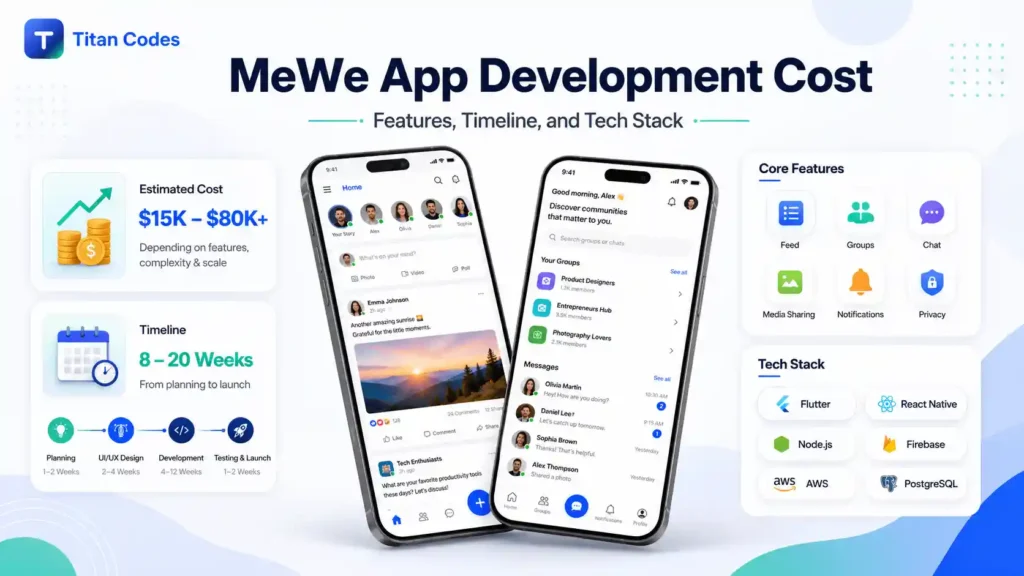
Building a social media app like MeWe can cost anywhere from $50,000 for a focused minimum viable product to more than $500,000 for a scalable platform with advanced messaging, video calling, subscriptions, moderation, and privacy controls.
That range is wide because a social networking app is not simply a collection of profiles and posts. It is a connected product ecosystem that needs authentication, user relationships, content feeds, real-time messaging, media storage, notifications, moderation tools, privacy controls, analytics, and reliable cloud infrastructure.
The business opportunity is significant. DataReportal estimated that there were 5.24 billion social media user identities worldwide at the beginning of 2025, representing 63.9 percent of the global population. The total increased by 206 million during the previous 12 months.
At the same time, users are increasingly concerned about how platforms collect and use personal information. A Pew Research Center study found that 73 percent of Americans felt they had little or no control over the data companies collected about them. It also found that 77 percent had little or no trust in social media executives to publicly take responsibility for data misuse.
This tension creates an opportunity for privacy-focused communities, professional networks, membership platforms, and niche social applications. However, success depends on much more than copying MeWe’s feature list.
This article explains the cost of building a social media app like MeWe, which features belong in an MVP, what technology the platform requires, and how to avoid spending heavily on a product that users do not adopt.
What is MeWe?
MeWe is a privacy-focused social networking platform positioned as an alternative to advertising-driven social media. It offers familiar social features such as profiles, feeds, groups, messaging, and content sharing while emphasizing user privacy and control.
MeWe says it has more than 20 million users and promotes a freemium model without targeted advertising, tracking, or manipulated news feeds. Paid services and premium features provide an alternative to monetizing user behavior for advertisers.
For founders, the important lesson is not to reproduce MeWe screen by screen. It is to understand the product principles behind the platform:
- Users control who can access their content.
- Privacy is part of the product architecture.
- Communities and groups create ongoing value.
- Premium services support an ad-free business model.
- Trust and transparency become competitive differentiators.
A new product still needs its own audience, positioning, brand, functionality, moderation policy, and monetization strategy.
How much does it cost to develop an app like MeWe?
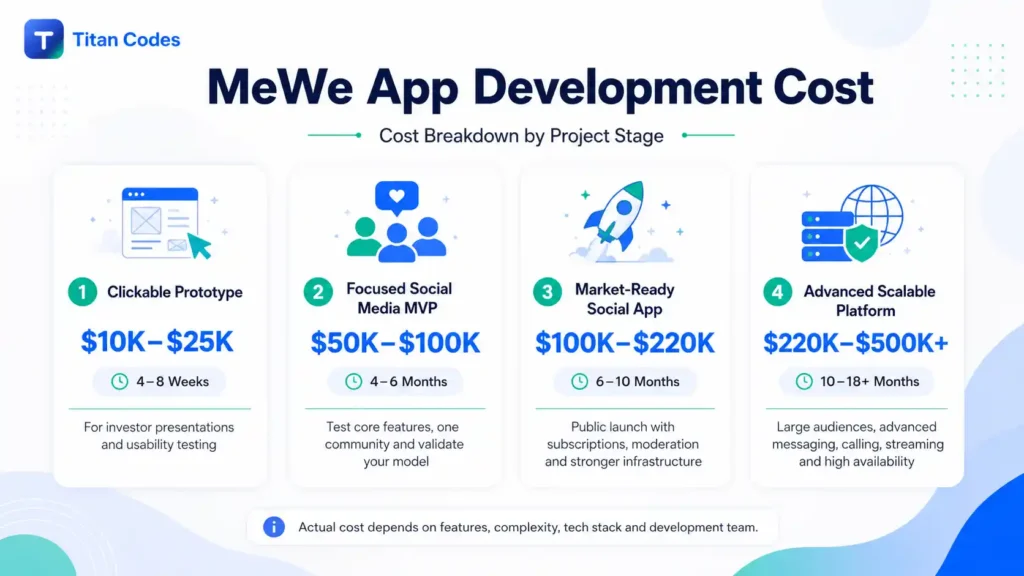
The following ranges provide a practical starting point.
| Product stage | Estimated cost | Typical timeline | Suitable for |
| Clickable prototype | $10,000 to $25,000 | 4 to 8 weeks | Investor presentations and usability testing |
| Focused social media MVP | $50,000 to $100,000 | 4 to 6 months | Testing one community and core product model |
| Market-ready social app | $100,000 to $220,000 | 6 to 10 months | Public launch with subscriptions, moderation, and stronger infrastructure |
| Advanced scalable platform | $220,000 to $500,000+ | 10 to 18+ months | Large audiences, advanced messaging, calling, streaming, and high availability |
These are planning estimates, not fixed quotations. They assume professional product strategy, UI/UX design, mobile development, backend engineering, quality assurance, cloud setup, and launch support.
A project developed entirely by senior U.S.-based specialists may cost more. A blended global development team can reduce costs, but the quality of product planning, architecture, security, and testing still matters.
Titan Codes treats mobile app development as a complete product system that includes the interface, backend APIs, authentication, notifications, analytics, administration, testing, and launch planning.
Cost breakdown by product stage
Clickable prototype: $10,000 to $25,000
A prototype demonstrates how the application will look and how users will move through important screens.
It may include:
- Onboarding
- Profile creation
- Home feed
- Post creation
- Group discovery
- Messaging interface
- Privacy settings
- Premium plan screens
A prototype does not usually include a production backend, real messaging, live notifications, or app store deployment.
It is useful when the team needs to test the concept, present it to investors, collect user feedback, or clarify requirements before engineering begins.
Professional UI/UX design can reduce expensive development changes by defining journeys, states, navigation, and reusable components before coding starts.
Focused MVP: $50,000 to $100,000
An MVP is the smallest usable product that lets real users experience the platform’s core value.
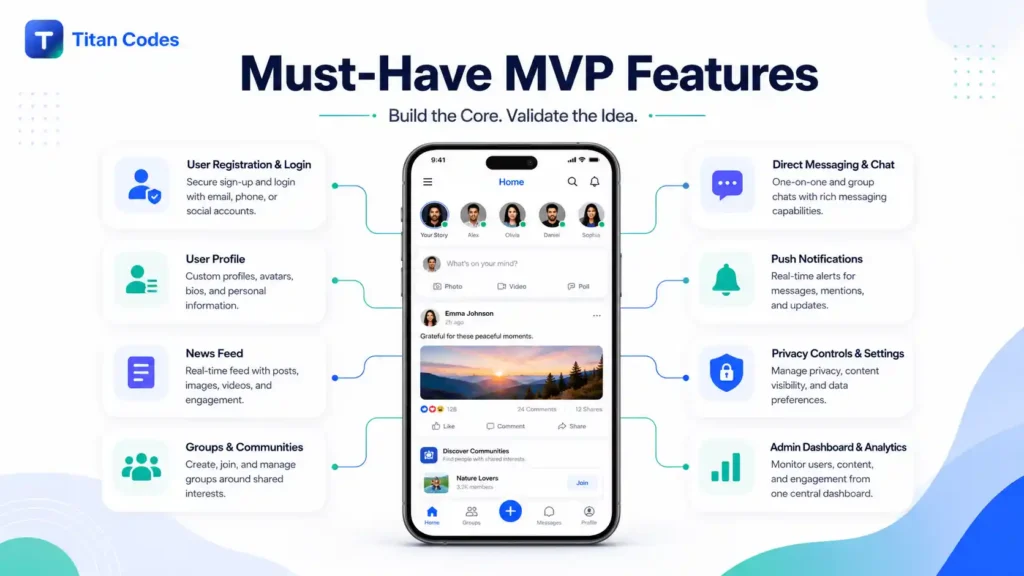
A reasonable MeWe-like MVP could include:
- Email or phone registration
- Secure login
- User profiles
- Connection requests or followers
- Text and image posts
- Chronological feed
- Comments and reactions
- Public or private groups
- Basic direct messaging
- Push notifications
- Privacy settings
- Blocking and reporting
- Administrative dashboard
- Basic analytics
The MVP should target a specific community rather than trying to compete with every large social network immediately.
Examples include:
- Professional associations
- Alumni communities
- Local interest groups
- Creator communities
- Private business networks
- Healthcare support communities
- Religious or nonprofit organizations
- Membership-based clubs
Starting with one identifiable audience reduces product complexity and helps solve the empty-network problem.
Titan Codes’ MVP development approach focuses on validating the core user workflow before investing in secondary features.
Market-ready application: $100,000 to $220,000
A market-ready product needs more operational depth than an MVP.
It may add:
- iOS and Android applications
- Web-based platform
- Advanced privacy controls
- Group administration
- Content search
- Media processing
- Subscription billing
- Premium accounts
- Stronger reporting tools
- Moderator workflows
- Audit logs
- Account deletion and export
- Production monitoring
- Performance testing
- Backup and recovery systems
- App store release management
This level is appropriate when the business already has a launch audience, a validated community need, and a realistic acquisition plan.
Advanced scalable platform: $220,000 to $500,000+
A full social networking platform may include:
- Real-time group messaging
- End-to-end encrypted conversations
- Voice and video calling
- Live streaming
- Stories and disappearing content
- Creator subscriptions
- Paid communities
- Advanced recommendations
- Multi-language support
- Automated moderation
- Large-scale media delivery
- Multi-region hosting
- High availability
- Disaster recovery
- Fraud detection
- Decentralized identity or data portability
Each advanced feature introduces additional backend services, security requirements, edge cases, and operational costs.
A platform of this size is normally developed in phases rather than as one uninterrupted launch project.
Which features influence MeWe app development cost?
Every feature affects design, backend logic, database structure, testing, and infrastructure.
The following estimates represent common feature groups. They are not intended to be added together mechanically because several components share the same backend and interface foundations.
| Feature group | Estimated development cost |
| Authentication and account security | $8,000 to $20,000 |
| Profiles and privacy settings | $10,000 to $25,000 |
| Social graph and connections | $12,000 to $30,000 |
| Posts, comments, reactions, and feed | $20,000 to $50,000 |
| Groups and communities | $12,000 to $30,000 |
| Direct and group messaging | $15,000 to $45,000 |
| End-to-end encryption | Additional $25,000 to $70,000 |
| Voice and video calling | $25,000 to $70,000 |
| Live streaming | $30,000 to $100,000+ |
| Media storage and processing | $15,000 to $40,000 |
| Search and discovery | $10,000 to $30,000 |
| Admin and moderation system | $15,000 to $45,000 |
| Subscriptions and payments | $8,000 to $25,000 |
| QA, security, and release preparation | $15,000 to $45,000 |
User registration and authentication
Basic registration may include email, password, and password reset functionality.
A stronger account system can include:
- Phone verification
- Multi-factor authentication
- Social login
- Passkeys
- Device management
- Login history
- Session revocation
- Suspicious login alerts
- Account recovery
- Age verification
Authentication affects every private feature in the platform. Weak account security can expose messages, personal content, payment details, and community data.
Profiles and granular privacy controls
A standard user profile is relatively straightforward. A privacy-focused profile is more complex.
Users may need to control:
- Who can view their profile
- Who can see individual profile fields
- Who can send connection requests
- Who can send messages
- Whether the profile appears in search
- Whether the user appears online
- Who can see specific posts
- Whether content can be reshared
- Whether location or activity status is visible
Every additional privacy option creates more interface states, database rules, permission checks, and testing scenarios.
Social graph
The social graph defines relationships between users.
Depending on the product, it may support:
- Mutual friendships
- One-way followers
- Group memberships
- Blocks
- Mutes
- Invitations
- Family or close-friend lists
- Custom audience groups
- Suggested connections
The social graph affects feed generation, privacy, search, messaging, notifications, and recommendations. Poor data modeling can lead to slow queries or permission errors as the network grows.
News feed and content sharing
A social feed is one of the largest development areas.
The application needs to determine:
- Which posts a user can see
- How posts are ordered
- How group and connection content is combined
- How blocked or muted accounts are excluded
- How deleted content disappears
- How privacy settings affect distribution
- How the feed performs during traffic spikes
A chronological feed is usually more suitable for an early MVP. Recommendation-based feeds require additional data collection, ranking logic, experimentation, and transparency controls.
Content types may include:
- Text
- Images
- Video
- Links
- Polls
- Documents
- Audio clips
- Reactions
- Comments
- Reposts
Video and audio increase both development and ongoing infrastructure costs.
Groups and communities
Groups are often the primary retention mechanism in a community-focused social app.
A group system may support:
- Public groups
- Private groups
- Hidden groups
- Join requests
- Invitation-only membership
- Member roles
- Moderators
- Group rules
- Pinned posts
- Events
- Polls
- Files
- Paid membership
Group administration also requires tools for reviewing members, removing posts, handling reports, managing permissions, and resolving disputes.
Messaging and encrypted chat
Basic messaging requires:
- Real-time delivery
- Conversation history
- Typing indicators
- Delivery status
- Read receipts
- Media attachments
- Notifications
- Blocking
- Message deletion
End-to-end encryption adds significant complexity.
Additional encryption requirements
A secure encrypted messaging system must address:
- Cryptographic key generation
- Key storage
- Multi-device synchronization
- Device replacement
- Group-chat membership changes
- Backup and recovery
- Encrypted media
- Message search
- Notification privacy
- Account recovery
Encryption can also limit moderation and server-side search because the platform may not be able to read message content.
This feature should only be added when it is central to the product promise and the development team has suitable security expertise.
Voice, video, and live streaming
Voice and video functionality commonly relies on WebRTC or a managed communication provider.
The product must handle:
- Device permissions
- Call signaling
- Microphone and camera controls
- Connection quality
- Network changes
- Group calls
- Missed calls
- Background behavior
- Recording policies
- Abuse reporting
- Bandwidth use
A managed provider can reduce development time for an MVP. Custom communication infrastructure provides more control but requires significantly more engineering and operational work.
Media storage and delivery
Photos, videos, voice messages, and documents generate recurring costs.
A media pipeline may need:
- Direct uploads
- Image compression
- Thumbnail generation
- Video transcoding
- Multiple playback formats
- Malware scanning
- Storage lifecycle policies
- Content delivery network distribution
- Deleted-file cleanup
- Backup handling
Media usage can become one of the platform’s largest expenses. Free accounts should have practical storage or upload limits unless the revenue model can support unlimited usage.
Search and discovery
Users may want to search for:
- People
- Groups
- Posts
- Topics
- Hashtags
- Events
- Files
Basic database search may work during an early launch. Larger platforms commonly require a dedicated search engine, indexing workflow, privacy filters, and ranking logic.
Search results must respect blocks, group membership, content visibility, and account privacy.
Subscription billing
An ad-free business model usually depends on direct revenue.
Subscription functionality may include:
- Monthly and annual plans
- Free trials
- App store purchases
- Web payments
- Upgrade and downgrade rules
- Failed-payment handling
- Receipts
- Refunds
- Promotional codes
- Regional pricing
- Tax handling
- Premium access management
Payment processing also requires secure webhook handling and synchronization between the payment provider and the user’s account status.
What should a MeWe-like MVP include?
A common founder mistake is trying to build the final vision before validating whether people will join and return.
A strong MVP should prove three things:
- The target audience wants the community.
- Users understand the product’s privacy promise.
- Users return because the network provides ongoing value.
Recommended MVP features
Account and identity
- Email or phone registration
- Password reset
- Basic profile
- Profile photo
- Privacy settings
- Account deletion
Community interaction
- Connections or follows
- Text and image posts
- Comments
- Reactions
- Chronological feed
- Public and private groups
Communication
- Basic one-to-one messaging
- Push notifications
- Blocking
- Reporting
Platform operations
- Admin dashboard
- User management
- Content review
- Basic analytics
- Error monitoring
- Data backups
Features to delay until after validation
The following features can increase cost without proving the central business idea:
- Live streaming
- Dual-camera video
- Advanced recommendation algorithms
- Custom emojis
- Stories and journals
- Complex encrypted backups
- Large group video calls
- Creator payouts
- Decentralized identity
- Advanced AI moderation
- Premium cloud storage
- Business pages
A feature should enter the MVP only when the core product cannot deliver its value without it.
Recommended technology stack
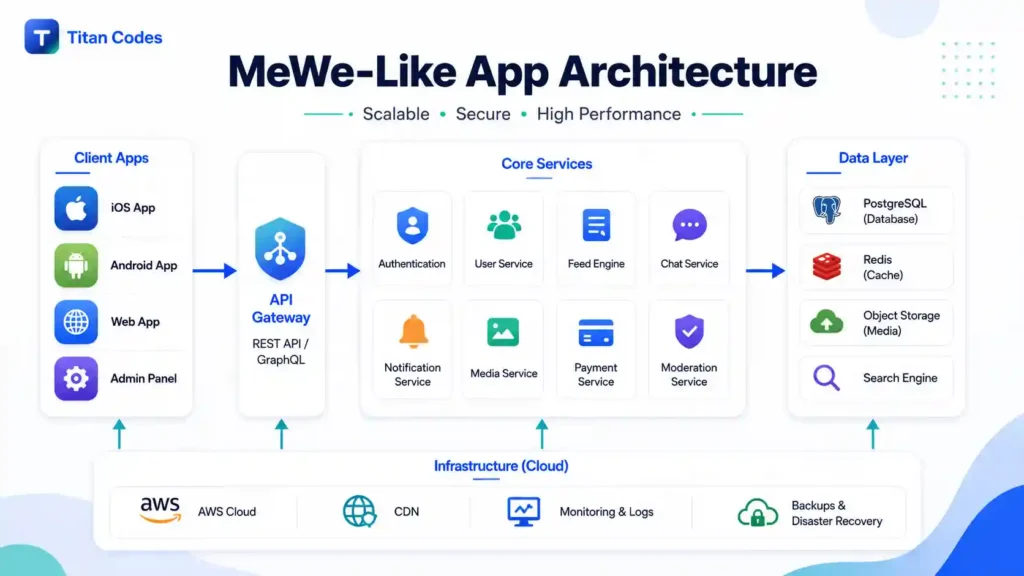
There is no universal technology stack for every social media application. The right architecture depends on expected usage, internal expertise, feature complexity, launch schedule, and long-term product plans.
Mobile applications
Common options include:
- React Native: Shared development for iOS and Android with a broad ecosystem
- Flutter: Cross-platform development with consistent interface rendering
- Swift: Native iOS development
- Kotlin: Native Android development
Cross-platform development is usually appropriate for an MVP because it allows the team to share more code between iOS and Android.
Native development may be preferable when the app requires advanced camera functionality, intensive media processing, highly platform-specific behavior, or maximum device performance.
Web application
A web version and administrative interface can use frameworks such as:
- React
- Next.js
- Vue
- Nuxt
The admin dashboard should be treated as an operational product, not an afterthought. Moderators and support staff need efficient workflows for reviewing reports, locating users, documenting actions, and resolving appeals.
Backend services
Suitable backend technologies may include:
- Node.js with NestJS
- Python with FastAPI or Django
- Java with Spring Boot
- PHP with Laravel
- Go for high-performance services
The backend typically handles:
- Authentication
- Profiles
- Relationships
- Posts
- Feeds
- Groups
- Messages
- Notifications
- Subscriptions
- Moderation
- Search indexing
- Analytics events
Custom API development and integration are often required to connect the mobile apps, admin dashboard, payments, notifications, storage, analytics, and third-party services reliably.
Databases and storage
A practical architecture may use:
- PostgreSQL for users, groups, subscriptions, and structured records
- Redis for caching, sessions, feed acceleration, and real-time state
- Object storage for photos, videos, audio, and files
- Elasticsearch or OpenSearch for content discovery
- A content delivery network for media distribution
A graph database may be useful for advanced relationship analysis, but it is not automatically required for the first version.
Real-time communication
Real-time features may use:
- WebSockets
- Managed messaging services
- Message queues
- WebRTC
- Push notification services from Apple and Google
The decision to build or buy messaging infrastructure should be based on expected scale, privacy requirements, and the team’s engineering capacity.
Cloud and DevOps
The cloud layer should support:
- Development, staging, and production environments
- Automated deployments
- Database backups
- Object storage
- Monitoring
- Log collection
- Error tracking
- Rate limiting
- Scaling
- Recovery procedures
Titan Codes provides cloud services for mobile backends, databases, deployment pipelines, storage, monitoring, backups, and practical scaling foundations.
Privacy and security requirements
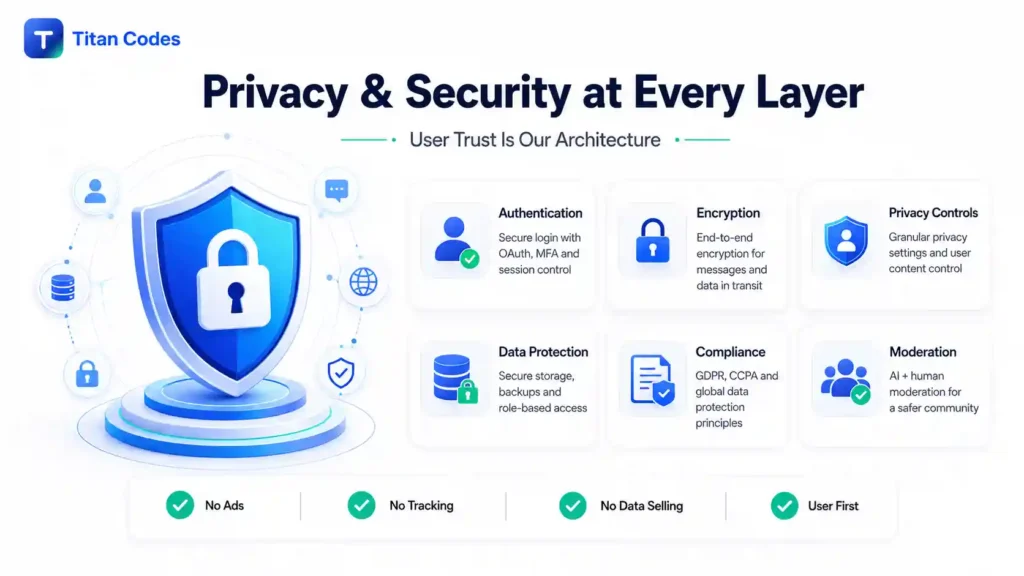
Privacy cannot be added shortly before launch. It affects the product requirements, data model, interface, infrastructure, analytics, and third-party integrations.
Data minimization
Only collect information the product genuinely needs.
A privacy-focused platform should document:
- What data is collected
- Why it is collected
- Where it is stored
- How long it is retained
- Who can access it
- Which third parties receive it
- How users can delete or export it
Collecting less data reduces exposure and can simplify compliance.
Permission-aware design
Privacy controls should be enforced by the backend, not only hidden in the interface.
The system must validate authorization whenever someone:
- Views a profile
- Loads a post
- Opens a group
- Downloads a file
- Sends a message
- Searches for an account
- Shares content
- Uses an administrative function
App store privacy declarations
Apple requires developers to disclose the data collected by an application and its third-party SDKs. These disclosures appear in the App Store’s privacy information, and developers are responsible for keeping them accurate. Apple’s app privacy guidance specifically includes user content, messages, photos, videos, audio, contacts, identifiers, purchases, and usage data.
Google Play similarly requires developers to complete a Data Safety form explaining how the app collects, shares, and protects user data, including information handled by third-party libraries and SDKs.
Security testing
A social app should be tested for:
- Broken access control
- Authentication weaknesses
- Insecure storage
- API abuse
- Injection vulnerabilities
- Session theft
- Account enumeration
- File upload attacks
- Rate-limit bypass
- Sensitive data exposure
- Administrative privilege escalation
The OWASP Mobile Application Security project provides standards and testing guidance for mobile application security.
Regulatory considerations
Applicable laws depend on the audience, location, data types, and business model.
A platform serving European users may need to account for the EU data protection framework, including lawful processing, transparency, access, correction, deletion, and portability requirements.
A U.S. application directed at children under 13, or one that knowingly collects their personal information, may also have obligations under the Children’s Online Privacy Protection Act. The Federal Trade Commission’s children’s privacy guidance should be reviewed when children may use the platform.
Legal counsel should confirm the requirements for the intended market. Software architecture alone does not establish legal compliance.
Content moderation is a core product requirement
A privacy-focused platform still needs rules and enforcement.
Without moderation, the platform may face:
- Spam
- Harassment
- Fraud
- Impersonation
- Illegal content
- Copyright complaints
- Coordinated abuse
- Misinformation
- Child-safety risks
- Threats and violent content
Essential moderation features
A market-ready platform should include:
- User reporting
- Blocking and muting
- Report categories
- Moderator queues
- Evidence preservation
- Warning and suspension tools
- Permanent bans
- Appeals
- Internal notes
- Audit history
- Emergency escalation
Moderation affects ongoing cost
Moderation is not completed when the code is delivered.
The company may need:
- Human moderators
- Support agents
- Policy specialists
- Legal escalation
- Trust and safety leadership
- Automated risk detection
- Moderator training
- Mental health support for reviewers
The cost depends on user volume, content types, geography, community behavior, and the platform’s policies.
How long does it take to build a MeWe-like app?
| Product stage | Expected timeline |
| Product discovery and prototype | 4 to 8 weeks |
| Focused MVP | 4 to 6 months |
| Market-ready application | 6 to 10 months |
| Advanced social platform | 10 to 18+ months |
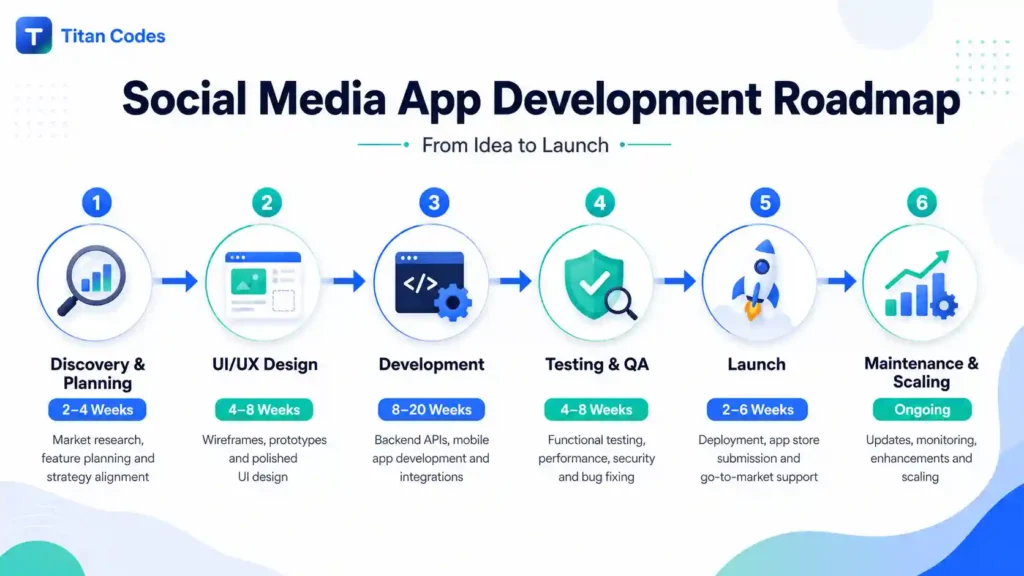
Phase 1: Product discovery
Typical duration: 2 to 4 weeks
The team defines:
- Target audience
- Core community problem
- Product differentiation
- Monetization
- Privacy model
- Essential features
- Release plan
- Success metrics
Phase 2: UX and interface design
Typical duration: 4 to 8 weeks
Design work includes:
- User journeys
- Wireframes
- Design system
- Mobile screens
- Admin workflows
- Privacy settings
- Interactive prototype
- Development handoff
Phase 3: Architecture and backend foundations
Typical duration: 4 to 8 weeks
The team establishes:
- Database structure
- Authentication
- API architecture
- Cloud environments
- Storage
- Permissions
- Deployment pipeline
- Monitoring foundations
Phase 4: Core feature development
Typical duration: 8 to 20 weeks
This phase normally includes profiles, relationships, feeds, groups, messaging, notifications, reporting, administration, and subscriptions.
Phase 5: Testing and security review
Typical duration: 4 to 8 weeks
Testing covers:
- User journeys
- Permissions
- Devices
- Network conditions
- Notifications
- Payments
- File uploads
- Performance
- Security
- Backup restoration
Phase 6: Beta and store launch
Typical duration: 2 to 6 weeks
A controlled beta allows the team to find usability, performance, moderation, and retention problems before a large public release.
What team is required?
A professional social media development team may include:
- Product manager
- Business analyst
- UI/UX designer
- Mobile developers
- Backend developers
- Web developer
- QA engineer
- DevOps or cloud engineer
- Security specialist
- Project manager
An MVP may be built by a smaller cross-functional team. An advanced platform usually needs dedicated engineers for messaging, media, infrastructure, security, data, and moderation tooling.
The cost depends as much on team composition and project management as it does on the number of screens.
Ongoing operating costs
Development is only the first part of the investment.
A social platform continues to generate expenses after launch.
| Usage stage | Indicative monthly operating cost |
| Private beta or early MVP | $1,000 to $5,000 |
| Growing community | $5,000 to $30,000 |
| Large or media-heavy platform | $30,000 to $150,000+ |
These ranges may include hosting, databases, storage, media delivery, monitoring, communication services, email, and technical maintenance. They do not necessarily include a full moderation and customer support workforce.
Major recurring expenses
- Cloud servers
- Databases
- Object storage
- CDN bandwidth
- Video transcoding
- Messaging services
- Voice and video providers
- Email and SMS
- Push infrastructure
- Search services
- Monitoring
- Security tools
- Backups
- Customer support
- Content moderation
- Software maintenance
- App store updates
A mostly text-based private community will cost considerably less to operate than a video-heavy network with live streaming and large group calls.
How can a MeWe-like app make money?
An ad-free platform needs a clear direct-revenue model.
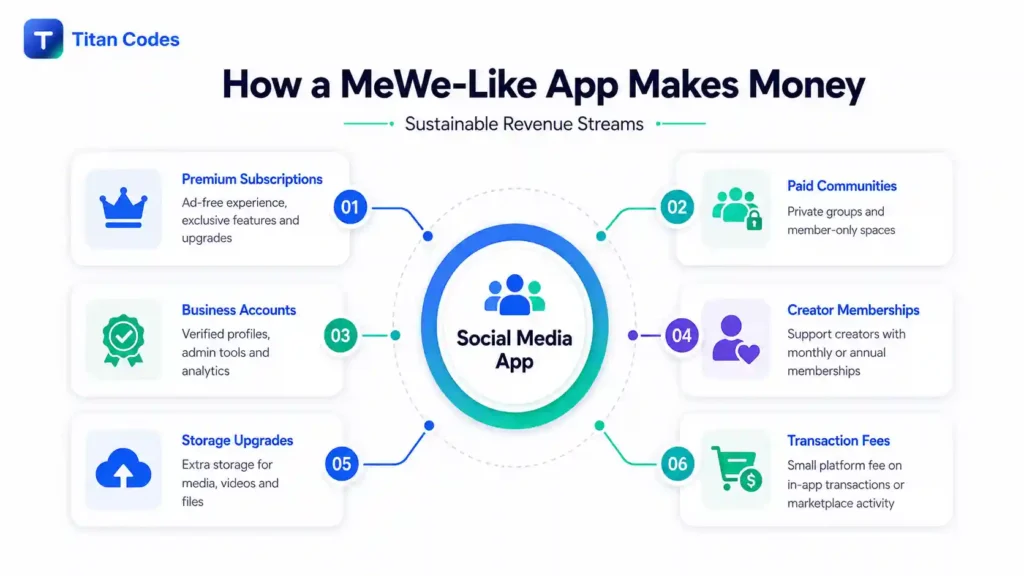
Freemium subscription
The free plan provides the core network experience. Premium users receive additional value such as:
- More storage
- Advanced privacy controls
- Custom themes
- Video calling
- Larger groups
- Premium support
- Enhanced profile options
The premium package must solve a meaningful need. Cosmetic upgrades alone may not create sufficient recurring revenue.
Paid communities
Group owners or creators can charge members for access.
The platform may collect:
- A monthly platform fee
- A percentage of membership payments
- Payment-processing fees
- Fees for premium management tools
This model works when community leaders already have an audience.
Storage upgrades
Paid storage directly connects revenue to one of the platform’s largest operating costs.
Users who upload significant amounts of media can purchase additional capacity.
Business and organization accounts
Businesses may pay for:
- Private employee communities
- Customer groups
- Member directories
- Moderation tools
- Analytics
- Administrative roles
- Branded spaces
- Integrations
- Priority support
Business accounts can produce more predictable revenue than individual consumer subscriptions.
Creator tools
Potential creator features include:
- Paid posts
- Tips
- Membership tiers
- Digital products
- Ticketed events
- Subscriber-only groups
Creator monetization also introduces payout processing, identity verification, fraud controls, tax reporting, and dispute handling.
How to reduce development cost responsibly
Cost reduction should come from scope discipline, not weak security or unfinished engineering.
Start with one audience
A focused community is easier to design, market, moderate, and monetize.
Use a chronological feed first
An early product rarely needs an expensive recommendation engine.
Choose cross-platform mobile development
React Native or Flutter can reduce duplicated work across iOS and Android.
Use managed services selectively
Managed authentication, messaging, calling, payments, search, and storage can shorten the MVP timeline.
Review each provider’s privacy terms, pricing model, export options, and long-term dependency before adoption.
Delay live video
Video calling and live streaming can consume a large share of the development and infrastructure budget.
Limit version-one media
Start with text and optimized images if video is not central to the business model.
Build moderation from the beginning
Retrofitting reporting and administrative tools after abuse begins is more expensive and riskier.
Validate monetization early
Test whether users or community owners will pay before investing in advanced premium functionality.
Create a phased product roadmap
A practical roadmap may look like this:
- Version 1: Profiles, feed, groups, messaging, privacy, moderation
- Version 1.5: Subscriptions, enhanced search, richer media
- Version 2: Calling, creator tools, advanced communities
- Version 3: Recommendations, live streaming, large-scale infrastructure
Should you build from scratch or use a white-label platform?
| Approach | Advantages | Limitations |
| No-code or low-code | Faster validation and lower initial cost | Limited scale, privacy control, and customization |
| White-label platform | Quicker launch with standard features | Vendor dependency and restricted ownership |
| Custom MVP | Original product with controlled scope | Higher initial investment |
| Fully custom platform | Maximum control over architecture and data | Highest cost and longest timeline |
A custom build is generally appropriate when the business requires:
- Unique community workflows
- Strong source-code ownership
- Granular permissions
- Custom monetization
- Specialized moderation
- Integration with other business systems
- Long-term product control
- Strict security or hosting requirements
A social network is effectively a custom software platform with mobile interfaces. Titan Codes combines custom software development with mobile applications, API development, administration systems, permissions, cloud infrastructure, and launch support.
How Titan Codes can help
Titan Codes helps founders and growing businesses plan, design, develop, and launch mobile applications and connected software platforms.
A social networking engagement can include:
- Product discovery
- Audience and workflow definition
- MVP prioritization
- UI/UX design
- iOS and Android development
- Backend architecture
- API development
- User roles and permissions
- Feed and group systems
- Messaging integrations
- Admin and moderation dashboards
- Subscription billing
- Cloud deployment
- Testing
- Analytics
- Store launch
- Post-launch maintenance
The goal is not to build every possible social feature. It is to identify the smallest reliable product that delivers value to a clear audience and creates evidence for the next investment stage.
Businesses planning a social networking platform can contact Titan Codes with their audience, feature priorities, privacy requirements, budget direction, and launch goals.
Final thoughts
The cost to build a social media app like MeWe depends on much more than profiles, posts, and messaging.
A serious budget must account for:
- Privacy architecture
- User permissions
- Social graph design
- Feed performance
- Messaging
- Media infrastructure
- Moderation
- Security
- Subscriptions
- Cloud operations
- Customer support
- Ongoing maintenance
A focused MVP can often be developed for $50,000 to $100,000. A market-ready platform may require $100,000 to $220,000, while a large-scale product with advanced communication and infrastructure can exceed $500,000.
Before requesting an estimate, answer three questions:
- Who is the first community the product will serve?
- Why will those users join and return?
- Which features are essential to prove that value?
Clear answers will produce a more accurate budget, a faster development process, and a much stronger chance of launching a sustainable social platform.
Frequently asked questions
1. How much does it cost to build an app like MeWe?
A focused MeWe-like MVP typically costs between $50,000 and $100,000. A market-ready product may cost $100,000 to $220,000, while an advanced platform with encrypted messaging, video calls, live streaming, and large-scale infrastructure can cost $220,000 to $500,000 or more.
2. How long does MeWe-like app development take?
A focused MVP usually takes four to six months. A market-ready social networking application may take six to ten months. Advanced platforms can require ten to eighteen months or longer, depending on feature complexity, security, scale, and testing requirements.
3. What features should a MeWe-like MVP include?
A practical MVP should include secure registration, user profiles, privacy controls, connections, text and image posts, a chronological feed, groups, basic messaging, notifications, blocking, reporting, and an administrative dashboard.
4. What technology stack is best for a privacy-focused social app?
A common stack includes React Native or Flutter for mobile development, Node.js, Python, or Java for backend services, PostgreSQL for structured data, Redis for caching, object storage for media, WebSockets for messaging, and AWS, Azure, or Google Cloud for hosting.
5. How can a MeWe-like app make money without advertising?
Common options include premium subscriptions, paid groups, storage upgrades, business accounts, creator memberships, transaction fees, tips, and paid community-management features.
6. What are the ongoing costs after launch?
Ongoing costs include cloud hosting, databases, storage, bandwidth, media processing, messaging services, monitoring, security, moderation, customer support, maintenance, and app store updates. Early products may spend $1,000 to $5,000 per month, while large media-heavy platforms may spend tens or hundreds of thousands of dollars monthly.