
Software projects rarely move exactly as planned. Customer expectations change, teams discover technical constraints, competitors introduce new features, and business priorities can shift while development is already underway.
That uncertainty is not unusual. PMI’s 2026 Pulse of the Profession found that 97% of project professionals had managed at least one complex project in the previous year. Nearly one-third of complex projects failed, compared with 13% of projects overall. While the research covers projects beyond software, it highlights the challenge of managing work where conditions are difficult to predict.
Adaptive Software Development, or ASD, was designed for that kind of environment.
What Is Adaptive Software Development?
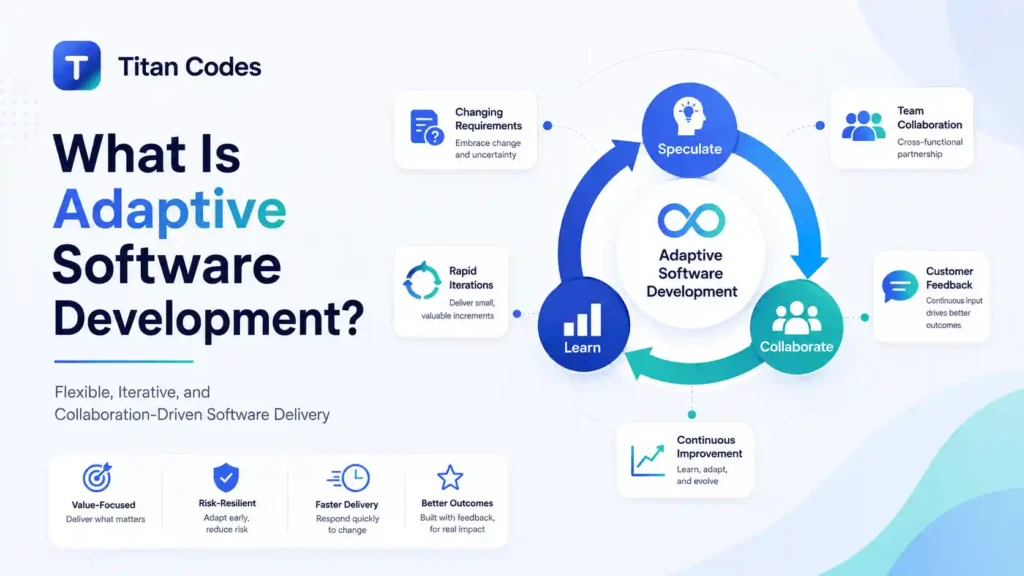
Adaptive Software Development is an iterative software development approach designed for complex projects where requirements, priorities, and technical understanding can evolve during development. Instead of treating the original project plan as fixed, ASD uses repeated cycles of Speculate, Collaborate, and Learn to adjust the product as the team gains new information.
Jim Highsmith was the primary developer of Adaptive Software Development and later became one of the original signatories of the Manifesto for Agile Software Development. His work on ASD focused on managing complex systems through adaptation, collaboration, and learning rather than trying to eliminate uncertainty through increasingly detailed upfront plans.
ASD developed from earlier Rapid Application Development practices and predates the Agile Manifesto. In fact, Adaptive Software Development was one of the lightweight development approaches represented when the 17 Agile Manifesto authors met in 2001.
The idea behind ASD is simple: plan enough to establish direction, build collaboratively, learn from real results, and revise the next step.
For businesses investing in custom software development, this mindset can be particularly useful when workflows, integrations, user needs, or product requirements cannot be fully understood before development begins.
How Does Adaptive Software Development Work?
The Adaptive Software Development lifecycle revolves around three recurring phases:
Speculate → Collaborate → Learn → Repeat
Unlike a sequential development model, the cycle continues throughout the project as new information becomes available.
1. Speculate
The Speculate phase establishes the direction of the project.
Calling this phase “speculation” is intentional. The team still creates a plan, but it accepts that some assumptions may turn out to be wrong.
Teams typically identify:
- The product or project mission
- High-priority features
- User and business needs
- Technical constraints
- Major risks
- Release or iteration objectives
The difference is that these decisions are treated as the best available direction, not an unchangeable specification.
This approach is especially useful during product development when teams are validating workflows, user behavior, integrations, or a new business model while building the product.
2. Collaborate
Once the direction is established, developers do not simply disappear and return months later with finished software.
Designers, engineers, QA specialists, product owners, business stakeholders, and sometimes end users work together to turn assumptions into usable features.
Collaboration matters because complex software decisions are rarely isolated. Changing a checkout flow might affect APIs, analytics, payments, database logic, customer support, and the user interface at the same time.
The goal is to make decisions using the combined knowledge of the people closest to the technical and business problem.
3. Learn
The Learn phase asks a critical question:
What did this iteration teach us that should change what we do next?
Teams can learn from:
- User feedback
- Quality assurance
- Product analytics
- Technical reviews
- Performance measurements
- Defects
- Stakeholder reviews
- Unexpected development constraints
The findings then influence the next Speculate phase.
This creates a feedback loop rather than a one-way delivery process. Highsmith’s work describes adaptation and collaboration as central to managing complex software systems.
Key Characteristics of Adaptive Software Development
An effective ASD lifecycle is typically built around several connected characteristics:
- Mission-focused: Decisions remain connected to the business outcome.
- Feature-based: Progress is judged through useful product capabilities rather than activity alone.
- Iterative: Software develops through repeated cycles instead of one large delivery.
- Time-boxed: Teams work within defined periods that force prioritization.
- Risk-driven: Important uncertainties and technical risks influence what should be addressed first.
- Change-tolerant: Change is expected and managed rather than automatically treated as project failure.
The important distinction is that ASD does not mean “build without a plan.” It means planning with the expectation that learning will improve the plan.
Adaptive Software Development vs Agile, Scrum and Waterfall
ASD, Agile, Scrum, and Waterfall are often discussed as if they were interchangeable methodologies. They are not.
| Approach | Core Idea | Planning Style | Response to Change | Best Fit |
| ASD | Continuous adaptation and learning | Adaptive | Very high | Complex, uncertain software projects |
| Agile | Values and principles for adaptive development | Flexible | High | Broad range of evolving product environments |
| Scrum | Empirical delivery through Sprints | Sprint-based | High | Teams wanting a defined Agile framework |
| Waterfall | Sequential development phases | Predictive | Lower | Projects with stable, well-understood requirements |
ASD vs Agile
Agile is broader than ASD.
The Agile Manifesto establishes values around working software, collaboration, people, and responding to change. ASD provides a more specific lifecycle centered on Speculate, Collaborate, and Learn.
ASD actually helped shape the thinking that eventually became part of the wider Agile movement.
ASD vs Scrum
Scrum provides considerably more defined structure.
According to the official Scrum Guide, Scrum defines accountabilities such as Product Owner, Scrum Master, and Developers, along with formal events including Sprint Planning, Daily Scrum, Sprint Review, and Sprint Retrospective. ASD focuses more heavily on adaptation and learning without prescribing the same operating structure.
In practice, software teams also rarely fit perfectly into a single methodology. A large international study involving 556 data points found that fewer than 15% of participants worked in purely traditional or purely Agile environments, with practices frequently evolving into hybrid approaches.
ASD vs Waterfall
Waterfall follows a more sequential path through requirements, design, development, testing, and deployment. PMI describes traditional sequential approaches as better suited to projects where requirements are well understood and unlikely to change.
ASD is more appropriate when important requirements are expected to emerge during the project.
Benefits and Limitations of Adaptive Software Development
Like any development approach, ASD works well under the right conditions and poorly under others.
Benefits of ASD
Responds better to changing requirements: Teams can revise priorities as customer or business needs change.
Encourages early learning: Teams do not have to wait until the final release to discover whether an assumption was wrong.
Improves stakeholder involvement: Regular collaboration keeps business and development decisions connected.
Helps expose risk sooner: Difficult integrations, architectural issues, or misunderstood requirements can surface during earlier iterations.
Supports incremental value: Useful features can be developed and evaluated without waiting for the entire system to be completed.
Limitations of ASD
ASD also requires discipline.
Frequent change can make cost and schedule forecasting harder. Stakeholders need to remain available, and teams need enough technical maturity to make decisions without relying on a highly prescriptive process.
There is also a difference between adaptability and uncontrolled scope creep. Changing priorities should be driven by evidence, risk, and business value, not by adding every new idea to the product.
When Should You Use Adaptive Software Development?
ASD is a strong option when:
- Requirements are likely to evolve
- The product involves significant technical uncertainty
- Users can provide feedback during development
- The team can deliver in short iterations
- Stakeholders are available for regular collaboration
- The project involves innovation or new product discovery
That makes it relevant to SaaS platforms, digital products, business systems, and complex web application development projects where the final workflow often becomes clearer as users interact with working software.
ASD may be less appropriate when requirements are contractually fixed, regulatory rules leave little room for change, or modifications become extremely expensive once implementation begins.
Adaptive Software Development Example
Consider a company building a SaaS customer portal.
The initial roadmap includes account management, billing, reports, notifications, and an analytics dashboard.
During Speculate, the team decides that account management, billing, and basic reporting should form the first release.
During Collaborate, developers, designers, and business stakeholders build and review those workflows together.
During Learn, beta customers reveal that advanced reporting is significantly more valuable than the planned notification system.
Instead of following the original roadmap simply because it was approved months earlier, the team adjusts the next iteration and prioritizes reporting.
That is ASD in practice. The mission remains stable, but the path to achieving it evolves.
For founders building similar products, our guide to the SaaS development timeline from MVP to launch explains how scope, feedback, integrations, and testing affect the delivery process.
Frequently Asked Questions About Adaptive Software Development
What are the three phases of Adaptive Software Development?
The three phases of Adaptive Software Development are Speculate, Collaborate, and Learn. Teams establish an initial direction, build through cross-functional collaboration, evaluate what they learned, and use that information to adjust the next iteration.
Is Adaptive Software Development an Agile methodology?
ASD predates the 2001 Agile Manifesto and was one of the development approaches represented during its creation. Today, ASD is generally associated with the broader Agile family because both emphasize collaboration, iterative delivery, feedback, and responding to change.
Is Adaptive Software Development still relevant today?
Yes, particularly as a way of thinking about complex product development. A team may use Scrum, Kanban, continuous delivery, or a hybrid operating model while still applying ASD principles such as iterative planning, collaboration, experimentation, feedback, and adaptation.
Final Thoughts
Adaptive Software Development recognizes something experienced software teams already know: you cannot predict every requirement, technical constraint, or user response before development begins.
The Speculate, Collaborate, and Learn cycle provides structure without assuming the original plan will always remain correct.
For businesses developing SaaS platforms, internal systems, portals, or other complex products, the real value of ASD is not simply flexibility. It is the ability to learn from working software and make better decisions before too much time and budget are committed to the wrong direction.
At Titan Codes, our SaaS development services and custom software development services are built around clear product goals, practical architecture, staged development, testing, and room for informed iteration as requirements become clearer.