
Your company may already have the answer to an important customer, employee, or operational question. The problem is finding it.
The information might be buried in a policy document, customer relationship management system, support ticket, product manual, shared drive, internal wiki, or database. Employees search several systems, ask subject matter experts, or rely on outdated documents. Meanwhile, a general-purpose AI assistant cannot reliably answer because it does not know your company’s current information.
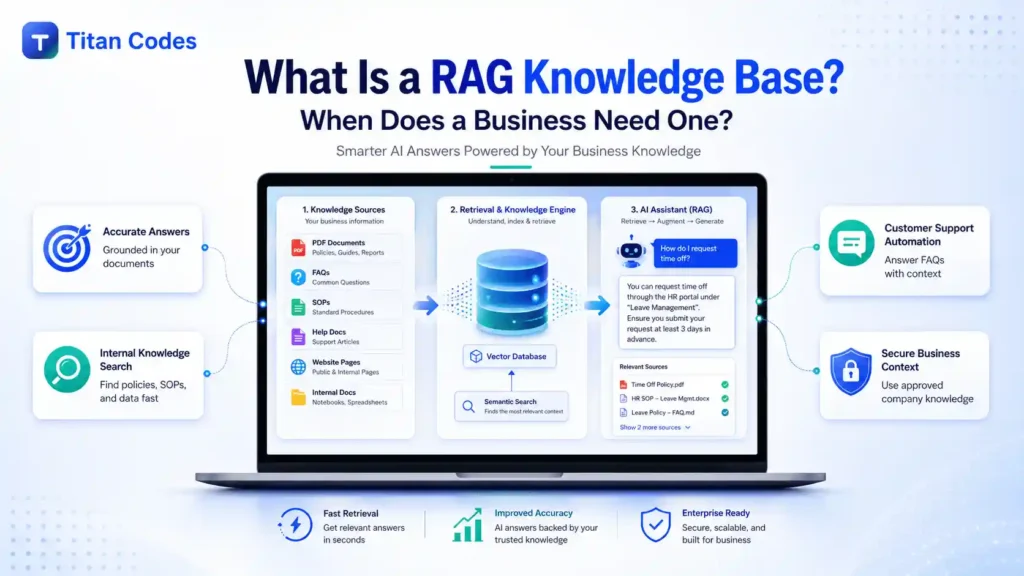
A RAG knowledge base addresses this problem by connecting artificial intelligence to approved business data. Instead of generating an answer from the model’s training alone, the system retrieves relevant company information and gives it to the model before it responds.
This distinction matters as businesses move from AI experiments to operational systems. According to McKinsey’s 2025 State of AI survey, 88 percent of respondents reported regular AI use in at least one business function. However, only about one-third said their organizations had begun scaling AI programs. The gap between using AI and creating measurable business value often comes down to data quality, workflow integration, governance, and access to reliable organizational knowledge.
A well-designed RAG knowledge base can help close that gap. It gives employees and customers a more direct way to use the information a business already owns.
What is a RAG knowledge base?
A RAG knowledge base is an AI system that retrieves information from approved data sources and uses that information to generate a relevant, source-grounded response.
RAG stands for retrieval-augmented generation:
- Retrieval: The system searches connected documents, records, databases, or other sources for information relevant to the question.
- Augmentation: The retrieved information is added to the context provided to the large language model.
- Generation: The model uses that context to produce a natural-language answer.
The original retrieval-augmented generation research paper, published in 2020, combined a generative model with access to an external, nonparametric memory. The researchers found that their RAG models produced more specific, diverse, and factual language than a comparable model relying only on information stored in its parameters.
In a business environment, the external memory can include:
- Product documentation
- Standard operating procedures
- Customer support articles
- Contracts and policies
- CRM records
- Internal wikis
- Training materials
- Technical manuals
- Previous support tickets
- Project documentation
- Approved website content
- Structured databases
- Real-time APIs
A RAG knowledge base is therefore more than a chatbot connected to a folder of PDFs. A production system must manage source quality, document versions, permissions, retrieval accuracy, citations, security, monitoring, and updates.
Businesses that need this complete architecture can explore RAG Knowledge Base AI services from Titan Codes, which are designed around approved sources, retrieval quality, answer controls, access boundaries, testing, and long-term maintainability.
How is a RAG knowledge base different from a traditional knowledge base?
A traditional knowledge base stores information and asks the user to find it.
A RAG knowledge base retrieves information and helps the user understand it.
With a traditional system, an employee may search for “enterprise refund approval” and receive a list of documents. The employee must open those documents, identify the current version, locate the relevant section, interpret it, and decide whether it applies to the situation.
With RAG, the employee can ask:
Who needs to approve a refund over $5,000 for an enterprise customer?
The system can search the current refund policy, identify the relevant approval rules, and produce a direct response with links or citations to the source.
| Capability | Traditional knowledge base | RAG knowledge base |
| User experience | Search terms and document navigation | Natural-language questions |
| Output | Documents or matching passages | Synthesized answer with sources |
| Search method | Primarily keyword-based | Semantic, keyword, structured, or hybrid retrieval |
| Context | User must interpret documents | AI combines relevant information |
| Source verification | User opens documents manually | Citations can be included in the answer |
| Personalization | Usually limited | Can incorporate user role, location, product, or account context |
| Permissions | Applied to documents or folders | Must also be enforced during retrieval |
| Updates | Search index must be refreshed | Sources, embeddings, metadata, and caches must be synchronized |
Traditional search still has value. Some users need the complete document, not an AI-generated summary. Strong enterprise systems often combine search, RAG, and direct access to original sources rather than replacing one with another.
Why standalone large language models are not enough for company knowledge
Large language models can write, summarize, classify, and reason over information. They do not automatically know the private or current facts inside your business.
Their training knowledge is limited
A model’s internal knowledge comes from its training process. It may not include your latest prices, policies, product releases, customer records, technical decisions, or operating procedures.
Even when a model knows something about your industry, it may not know how your organization handles a specific situation.
They can produce plausible but unsupported answers
Large language models generate probable sequences of words. A fluent response is not necessarily a correct response.
When the model lacks the required information, it may:
- Provide a generic answer
- Combine unrelated facts
- Use outdated information
- Misinterpret company terminology
- Invent a policy, process, or citation
- Respond confidently when it should say that evidence is unavailable
RAG helps reduce this risk by supplying relevant evidence. It does not eliminate the risk completely.
The retrieved document may itself be outdated. The search system may return the wrong passage. A poorly constructed prompt may encourage the model to go beyond the evidence. Conflicting sources may produce an ambiguous response.
For this reason, RAG should be treated as a controlled information system, not a guarantee of truth.
They do not understand access permissions by default
An employee may be authorized to view general operating procedures but not executive compensation, legal correspondence, medical records, or another customer’s data.
A model cannot be trusted to infer these boundaries. Authorization must be enforced before information is retrieved and placed into the prompt.
OpenAI has described using documents stored with metadata and permissions in its own internal data agent, with a retrieval service applying access control at runtime. This illustrates an important production principle: security belongs in the retrieval architecture, not only in the chatbot interface.
How does a RAG knowledge base work?
A business RAG system has two broad operating phases:
- Preparing and maintaining the knowledge
- Retrieving and using it when a question is asked
Phase one: Preparing business knowledge
Connect the knowledge sources
The system first needs access to the information it will use.
Sources may include SharePoint, Google Drive, Notion, Confluence, Salesforce, HubSpot, support platforms, SQL databases, cloud storage, websites, or internal APIs.
Connecting these systems may require authentication, webhooks, scheduled synchronization, change detection, or custom API development and integration.
The objective is not to copy every piece of company data into one unrestricted repository. It is to identify approved sources and preserve important information about ownership, permissions, versions, and update status.
Parse and clean the content
Business documents are rarely ready for AI retrieval.
They may contain:
- Repeated headers and footers
- Outdated drafts
- Duplicate files
- Scanned pages
- Broken tables
- Navigation text
- Incomplete records
- Conflicting versions
- Unsupported file formats
- Missing ownership information
The ingestion pipeline extracts useful content and removes noise before indexing.
A 2025 practitioner study on data quality in RAG systems identified 15 data-quality dimensions across extraction, transformation, search, prompting, and generation. The researchers found that quality problems often begin in the early pipeline and propagate into later outputs, supporting the need for quality management before retrieval tuning.
Split documents into meaningful chunks
Large documents are divided into smaller sections called chunks.
Chunking allows the system to retrieve the specific section that answers a question instead of sending an entire manual or policy to the model.
The best chunking method depends on the content. A legal contract, product catalog, technical manual, support ticket, and employee handbook should not necessarily be divided in the same way.
Useful boundaries may include:
- Headings and subheadings
- Individual policies
- Contract clauses
- Product specifications
- Support issue summaries
- Question-and-answer pairs
- Database records
- Procedural steps
Chunks that are too large introduce irrelevant content. Chunks that are too small can separate a statement from the context needed to interpret it.
Add metadata and permissions
Each chunk should carry information that helps the system retrieve and govern it.
Metadata may include:
- Document title
- Department
- Product
- Customer
- Region
- Language
- Effective date
- Version
- Author
- Approval status
- Confidentiality level
- User roles
- Source URL
- Last updated date
Metadata filters can narrow the search before semantic retrieval. For example, a support agent may only need content related to a specific product, region, and active policy version.
Create embeddings and searchable indexes
An embedding model converts each chunk into a numerical representation that captures semantic meaning.
These representations are commonly stored in a vector database. When a user asks a question, the question is converted into the same type of representation so the system can find conceptually similar content.
Vector search is useful, but it should not be the only retrieval method in every project. Exact product numbers, error codes, policy names, customer IDs, and legal phrases may work better with keyword or structured search.
Production RAG systems often use hybrid retrieval, combining:
- Semantic vector search
- Keyword search
- Metadata filtering
- Database queries
- Knowledge graph traversal
- API lookups
Phase two: Answering a business question
Understand the query
The system receives the user’s question and may rewrite or classify it before searching.
For example:
Can I issue this customer a refund?
This question may require the system to identify:
- The customer
- The product or plan
- The purchase date
- The refund amount
- The user’s role
- The current policy
- Whether manager approval is required
A strong RAG system retrieves based on the business context, not just the words in the sentence.
Apply authorization controls
Before retrieving information, the system should confirm what the user is allowed to access.
This can involve:
- User authentication
- Role-based access control
- Customer or tenant isolation
- Department restrictions
- Geographic restrictions
- Document-level permissions
- Row-level database permissions
Filtering after generation is not sufficient. Sensitive content should never be added to the model’s context for an unauthorized user.
Retrieve and rerank evidence
The retrieval layer finds potentially relevant passages.
A reranking model or scoring method can then reorder the results based on how directly they answer the question. This step can improve the quality of the context passed to the language model.
The objective is not to retrieve as much information as possible. It is to retrieve the smallest set of authoritative evidence needed to answer correctly.
Build the augmented prompt
The system combines:
- The user’s question
- Retrieved evidence
- Source metadata
- Response instructions
- Business rules
- Citation requirements
- Refusal conditions
- Output format
The prompt may tell the model to answer only from the supplied evidence, identify conflicts, cite each material claim, and refuse when the sources are insufficient.
Generate and cite the answer
The language model turns the evidence into a clear response.
A useful answer may include:
- The direct answer
- Relevant conditions or exceptions
- The effective date
- Links to source documents
- A confidence or evidence indicator
- A recommended next step
- An escalation option
Citations improve traceability, but they must be tested. A citation is valuable only when the referenced source actually supports the claim.
Log, evaluate, and improve
Each interaction creates useful operational data:
- What users ask
- Which sources are retrieved
- Which questions fail
- Which documents are missing
- How long responses take
- Whether users accept the answer
- When escalation occurs
- How much each query costs
This information supports continuous improvement of the sources, retrieval rules, prompts, and user experience.
The OpenAI knowledge retrieval blueprint emphasizes optimizing chunking, indexing, retrieval, groundedness evaluation, and deployment rather than treating retrieval as a one-time setup.
What business problems can a RAG knowledge base solve?
The strongest RAG use cases start with an expensive information problem, not a desire to add AI to the business.
| Business problem | RAG application | Potential outcome |
| Employees search multiple systems for answers | Internal knowledge assistant | Less search time and fewer interruptions |
| Support agents give inconsistent answers | Support knowledge copilot | Faster, more consistent resolution |
| Customers cannot find product information | Customer-facing knowledge chatbot | Faster self-service and fewer repetitive tickets |
| New employees repeatedly ask the same questions | Onboarding and policy assistant | Reduced HR and manager workload |
| Sales teams lack account context | CRM-connected sales assistant | Better meeting preparation and follow-up |
| Technical knowledge is scattered | Engineering documentation assistant | Faster troubleshooting |
| Policies change frequently | Version-aware policy search | Lower risk of outdated advice |
| Auditors need supporting evidence | Source-cited compliance assistant | Better traceability |
| Subject matter experts answer routine questions | Expert knowledge retrieval | More time for complex work |
Customer support
Support teams often search product documentation, account records, previous tickets, troubleshooting instructions, and policy pages before answering a customer.
A RAG knowledge base can retrieve these sources and prepare an answer for the agent. A customer-facing implementation can also answer approved routine questions directly and escalate sensitive or unresolved requests.
LinkedIn researchers reported that a customer-service system combining RAG with a knowledge graph improved mean reciprocal rank by 77.6 percent over the baseline used in the study. After approximately six months of deployment, the system reduced median per-issue resolution time by 28.6 percent. These results are specific to LinkedIn’s implementation, but they show how better retrieval can translate into a measurable operational outcome.
A company that needs a customer-facing interface can combine its knowledge layer with AI chatbot development for conversation design, lead capture, support triage, and human handoff.
Internal knowledge management
Employees frequently need information that exists but is difficult to locate:
- How does the approval process work?
- Which product version supports this feature?
- What is the current travel policy?
- How should this incident be escalated?
- Where is the latest proposal template?
- Who owns this customer account?
- What changed in the latest procedure?
A RAG assistant can search across approved sources and return one answer with references.
This is especially valuable when knowledge is distributed across departments or tools. The assistant should still respect the permissions of each underlying system.
Sales enablement
A sales representative may need to combine CRM activity, product information, previous meeting notes, pricing rules, customer emails, and case studies.
A RAG system can help prepare:
- Account summaries
- Meeting briefs
- Product comparisons
- Objection responses
- Relevant case studies
- Follow-up drafts
- Renewal risk summaries
RAG should retrieve the evidence. An AI automation system or agent can then update the CRM, create a task, or prepare a follow-up for human approval.
Employee onboarding and HR support
New employees often ask predictable questions about benefits, leave, security, expenses, remote work, internal tools, and operating procedures.
A permission-aware RAG knowledge base can answer these questions from approved HR documents. It can also identify when the question requires a human response.
Sensitive areas such as compensation, employee records, medical information, investigations, or legal matters require stricter access control and escalation.
Product and technical documentation
Software companies may have technical information distributed across API documentation, release notes, Git repositories, issue trackers, architecture records, and runbooks.
A RAG assistant can help developers and customers:
- Find implementation instructions
- Identify relevant code examples
- Compare software versions
- Locate known issues
- Review release changes
- Troubleshoot errors
- Retrieve incident procedures
For high-velocity systems, document synchronization is critical. An assistant should not recommend an endpoint, configuration, or runbook that was deprecated yesterday.
Financial, legal, and compliance research
RAG can help professionals retrieve clauses, policies, filings, procedures, and supporting records. It can reduce the time required to locate evidence and prepare an initial summary.
It should not independently make high-stakes legal, medical, credit, or financial decisions.
In these environments, the system should provide source evidence, identify uncertainty, preserve an audit trail, and route final decisions to qualified professionals.
Enterprise knowledge adoption at scale
Morgan Stanley Wealth Management is a prominent example of a company using an AI assistant to improve internal knowledge access. OpenAI reports that more than 98 percent of Morgan Stanley advisor teams actively use its internal AI assistant to retrieve information from the firm’s knowledge base and support client needs.
The important lesson is not that every business needs the same architecture. It is that adoption improves when the system is connected to a valuable workflow and gives users access to trusted information they need regularly.
When does a business need a RAG knowledge base?
A RAG knowledge base becomes a strong investment when several of the following conditions are present.
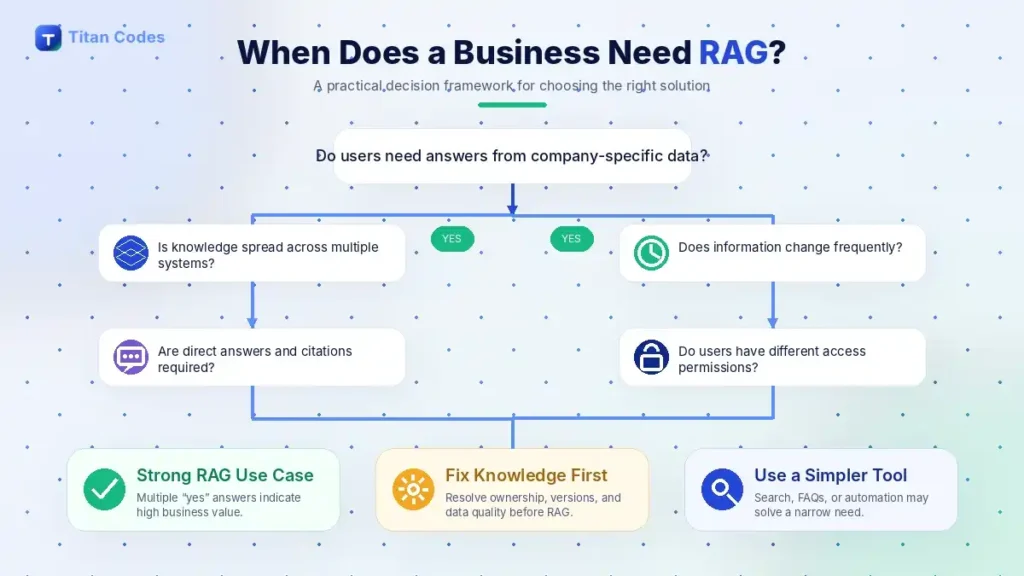
Employees ask the same knowledge questions repeatedly
Subject matter experts, managers, HR teams, support leaders, and engineers may spend significant time answering questions that are already documented.
RAG can make that knowledge available without requiring the expert to repeat the explanation every time.
Information is scattered across multiple systems
A traditional search tool may work within one repository. It is less useful when the answer depends on information stored across a wiki, CRM, ticketing platform, shared drive, and database.
RAG can provide a unified interaction layer while preserving the original systems as sources of record.
The knowledge changes regularly
Frequently changing product, policy, pricing, inventory, or technical information is a strong reason to consider retrieval.
The knowledge can be updated without retraining the language model. However, the ingestion and indexing process must detect and process those updates.
Query-time retrieval does not automatically mean the underlying information is current.
Users need direct answers, not lists of documents
Employees may know that the information exists but still lose time interpreting long documents.
RAG is useful when the business wants an answer synthesized from evidence, not just another search results page.
Answers need citations or traceability
Source links matter in compliance, finance, legal, healthcare, technical support, and policy-heavy environments.
A RAG system can record which sources were used, which version was retrieved, and how the answer was generated.
Different users need different information
A customer, support agent, manager, administrator, and executive should not necessarily receive the same data.
RAG can apply role, tenant, region, product, and account filters during retrieval.
Search delays create measurable business cost
The business case becomes stronger when poor knowledge access causes:
- Long support resolution times
- Slow employee onboarding
- Repeated expert interruptions
- Missed sales opportunities
- Inconsistent customer answers
- Delayed incident response
- Compliance review overhead
- Duplicate work
- Operational errors
The organization has an authoritative source of truth
RAG works best when the business can identify approved sources and knowledge owners.
If nobody knows which policy, price list, contract, or process is current, AI cannot solve the governance problem by itself.
It may retrieve conflicting information more quickly, but it cannot decide which source the company officially recognizes without rules or human ownership.
When does a business not need RAG?
RAG is not the right architecture for every AI project.
The business only needs a small FAQ
A structured FAQ page or rule-based chatbot may be simpler, cheaper, and easier to control when the questions and answers are limited and rarely change.
The answer requires an exact database calculation
Questions such as these should usually be handled by a database, analytics system, or deterministic tool:
- How many orders were placed yesterday?
- What was gross margin last quarter?
- Which invoices are overdue?
- How many open tickets meet these conditions?
A RAG system can explain the result, but the underlying calculation should come from a reliable query or business logic.
The main goal is to change the style or behavior
Fine-tuning or prompt engineering may be more appropriate when the company wants the model to follow a particular tone, structure, classification method, or output format.
RAG is primarily designed to provide knowledge at the time of the request.
The data is not reliable enough
Do not build a RAG system on top of uncontrolled duplicates, expired policies, missing permissions, and contradictory content without first addressing those issues.
The query volume and business value are low
A complex retrieval platform may not be justified when only a few users ask occasional low-value questions.
Existing search already solves the problem
Some teams need better indexing, filters, content organization, or search relevance, not a generative AI layer.
The business expects RAG to replace professional judgment
RAG can surface evidence and support decisions. It should not be positioned as an autonomous authority in high-risk situations.
RAG knowledge base vs. other AI approaches
Choosing the correct architecture prevents unnecessary cost and complexity.
| Approach | Best suited for | Main limitation |
| Prompt engineering | Instructions, format, tone, and simple behavior control | Cannot access large private knowledge sources by itself |
| Fine-tuning | Specialized behavior, terminology, style, or task performance | Knowledge becomes difficult to update and may not be traceable |
| Traditional search | Returning documents, pages, and records | User must interpret the results |
| Semantic search | Finding conceptually related content | Does not automatically synthesize an answer |
| Vector RAG | Question answering over documents | Can struggle with exact terms, relationships, and calculations |
| Hybrid RAG | Combining semantic and keyword retrieval | Requires more retrieval design and evaluation |
| Graph RAG | Questions involving relationships and connected entities | More complex data modeling and maintenance |
| Knowledge-based RAG | Rules, ontology, inference, aggregation, and domain logic | Requires domain modeling and expert input |
| Text-to-SQL | Exact questions over structured databases | Requires schema control, query validation, and security |
| Agentic RAG | Retrieval followed by tools and multi-step actions | Introduces greater security, testing, and governance requirements |
RAG vs. fine-tuning
RAG changes the information available to the model at query time.
Fine-tuning changes aspects of the model’s learned behavior.
Use RAG when information changes frequently or must be cited. Use fine-tuning when the model needs consistent specialized behavior. Some systems use both.
RAG vs. semantic search
Semantic search retrieves passages based on meaning.
RAG uses retrieved passages to generate an answer.
A business may deploy semantic search without generation, especially when users must read the original documents.
RAG vs. Graph RAG
Basic vector RAG treats content primarily as passages of text.
Graph RAG models relationships among entities such as customers, products, incidents, employees, suppliers, and policies. It can be useful when questions depend on those relationships.
The LinkedIn customer-service implementation shows why this matters. Historical support issues had useful internal structure and relationships that plain text retrieval did not fully preserve.
RAG vs. an AI agent
A RAG knowledge base retrieves and explains information.
An AI agent can use that information to choose steps and call approved tools.
For example:
- RAG answers, “What is the refund policy?”
- An agent checks the order, verifies eligibility, prepares the refund request, and sends it to a manager for approval.
Businesses considering tool-connected workflows can explore AI agent development services and review the factors that influence AI agent development cost.
What makes a RAG knowledge base enterprise-ready?
A prototype can work with a few documents and sample questions. A production system must operate reliably across real users, changing data, security requirements, and edge cases.
Approved and governed knowledge sources
Every important source should have:
- A business owner
- An approval status
- A current version
- A last-reviewed date
- An update process
- An access classification
- A deletion or retention rule
The business should also decide how the system handles conflicting information.
Hybrid retrieval
Semantic search is valuable, but exact matching remains important.
A production retrieval layer may combine vector search, keyword search, metadata filters, SQL queries, APIs, and knowledge graphs depending on the question.
Reliable citations
The system should test whether:
- The citation exists
- The user can access it
- It supports the claim
- It points to the correct version
- It remains available after the answer is generated
Permission-aware retrieval
Authorization should be applied before context reaches the model.
Sensitive information should be separated through metadata, namespaces, tenant boundaries, database policies, and application-level controls.
Prompt injection protection
RAG systems can retrieve malicious instructions hidden in documents, web pages, support tickets, or other sources.
The OWASP RAG Security Cheat Sheet identifies prompt injection, sensitive-information disclosure, poisoned content, and embedding or vector database weaknesses as important risks for RAG applications.
Security measures can include:
- Restricting ingestion to approved sources
- Scanning and sanitizing content
- Separating system instructions from retrieved text
- Treating retrieved content as untrusted data
- Detecting suspicious instructions
- Limiting model and tool permissions
- Testing adversarial queries
- Monitoring unusual retrieval behavior
- Preserving audit logs
Freshness and deletion controls
When a policy changes, the system must update the searchable representation and stop retrieving the old version.
When a source is deleted or access is revoked, related chunks, embeddings, indexes, and caches must also be removed or updated.
Evaluation before launch
A RAG system needs a test set based on real business questions.
The test set should include:
- Simple lookup questions
- Multi-document questions
- Missing-answer questions
- Conflicting-source questions
- Outdated-document tests
- Unauthorized-access tests
- Ambiguous questions
- Exact calculation questions
- Prompt injection attempts
- Citation validation
- Escalation scenarios
Observability after launch
Teams should be able to inspect:
- User query
- Retrieved passages
- Retrieval scores
- Applied filters
- Prompt version
- Model response
- Citations
- Latency
- Token use
- User feedback
- Errors and escalations
Production systems may also need scalable hosting, backups, monitoring, deployment controls, and recovery planning. These requirements can be addressed through an appropriate cloud services architecture.
How should a business measure RAG performance?
A RAG system should be evaluated at four levels.
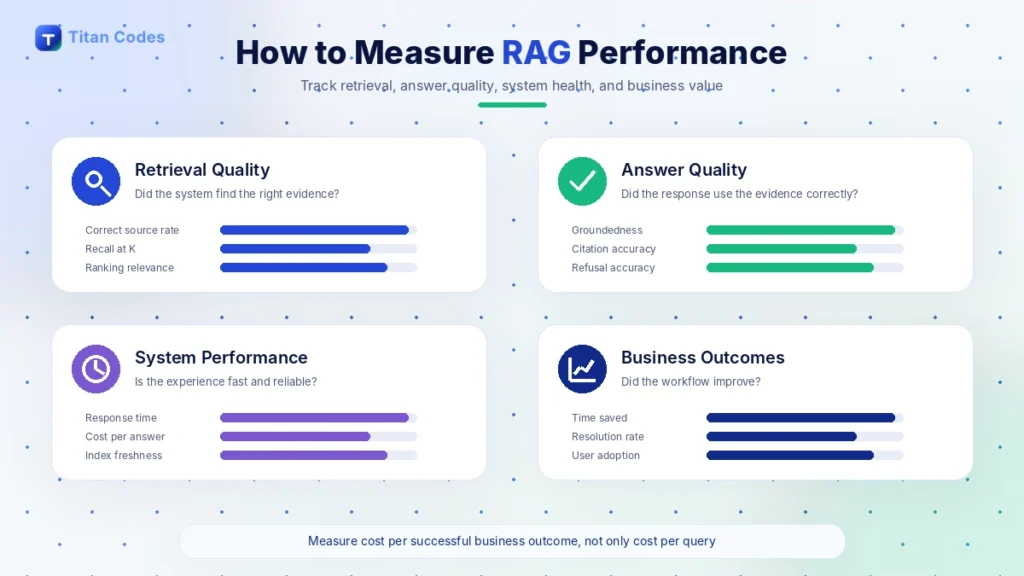
Retrieval quality
Measure whether the system found the correct evidence.
Useful metrics include:
- Correct-source retrieval rate
- Precision at K
- Recall at K
- Mean reciprocal rank
- Reranker relevance
- Permission-filter accuracy
Answer quality
Measure whether the response correctly used the evidence.
Useful metrics include:
- Factual correctness
- Groundedness
- Faithfulness
- Completeness
- Citation accuracy
- Refusal accuracy
- Escalation accuracy
System performance
Measure whether the experience is operationally viable.
Useful metrics include:
- End-to-end response time
- Retrieval latency
- Generation latency
- Cost per query
- Cost per successful answer
- Failed ingestion jobs
- Index freshness
- Availability
- Error rate
Business performance
Measure whether the system improves the workflow.
Useful metrics include:
- Average time to find an answer
- Support resolution time
- First-contact resolution rate
- Ticket deflection
- Subject matter expert interruptions
- Employee onboarding time
- User adoption
- Answer acceptance rate
- Escalation rate
- Hours saved
- Revenue influenced
- Cost per resolved request
Technical accuracy without business adoption creates little value. A system can retrieve excellent answers and still fail if it is slow, difficult to use, disconnected from daily work, or unsupported by the team.
How to estimate the ROI of a RAG knowledge base
RAG ROI should be tied to a specific workflow.
A practical model is:
Annual value = time savings + reduced support cost + productivity gains + revenue impact + avoided risk
Then subtract:
- Initial development
- Data preparation
- Integration
- Model usage
- Vector or search infrastructure
- Hosting
- Monitoring
- Evaluation
- Security
- Ongoing content maintenance
Example ROI calculation
Assume a support team has 25 agents.
Each agent spends an average of 45 minutes per day searching for internal information. The fully loaded labor cost is $45 per hour.
Annual search cost:
25 agents × 0.75 hours × $45 × 250 working days = $210,937.50
If a RAG assistant reduces that search time by 40 percent:
Estimated annual labor value = $84,375
The business should then compare that value with implementation and operating costs. Additional benefits may come from faster resolution, better consistency, fewer escalations, and improved customer satisfaction.
This calculation is illustrative. Actual ROI should be measured using observed baseline and post-launch data.
What does a successful RAG implementation process look like?
A reliable implementation moves through controlled stages.
1. Define the business question
Start with a narrow workflow.
Examples include:
- Help support agents answer product questions
- Give employees access to current policies
- Help developers search technical documentation
- Prepare account briefs from CRM records
- Retrieve clauses from approved contracts
The use case should include target users, expected questions, required sources, risks, and success metrics.
2. Audit the knowledge
Identify:
- Approved sources
- Source owners
- Duplicate content
- Outdated versions
- Missing information
- Permission requirements
- Update frequency
- Data formats
- Connection methods
This step determines whether the business is ready to build.
3. Design the retrieval architecture
Choose the appropriate combination of:
- Keyword search
- Vector search
- Hybrid search
- Metadata filters
- SQL queries
- APIs
- Knowledge graphs
- Reranking
The architecture should match the question types, not technology trends.
4. Build a representative evaluation set
Collect real questions from the intended users.
Include successful cases, edge cases, missing evidence, conflicting sources, and unauthorized requests.
5. Develop a controlled prototype
Connect a limited set of trusted sources and test the end-to-end workflow.
The objective is to validate retrieval and business value before expanding scope.
6. Add security and operational controls
Implement authentication, authorization, logging, source tracking, error handling, monitoring, and escalation.
7. Integrate with the working environment
The system may be delivered through:
- Website chat
- Internal web application
- Slack
- Microsoft Teams
- CRM interface
- Support platform
- Mobile application
- Browser extension
- Existing enterprise portal
A custom interface or workflow may require custom software development in addition to the RAG layer.
8. Launch to a controlled user group
Begin with users who understand the workflow and can provide useful feedback.
Review failed questions, source gaps, incorrect citations, and confusing interactions before wider deployment.
9. Improve continuously
RAG maintenance includes:
- Adding and removing sources
- Reprocessing changed documents
- Updating permissions
- Reviewing failed queries
- Tuning retrieval
- Updating evaluation sets
- Monitoring costs
- Testing model changes
- Retraining rerankers when needed
- Improving source content
Common RAG implementation mistakes
Indexing everything without a use case
More content does not automatically improve answers. It can increase noise, cost, and security risk.
Start with the sources required for one valuable workflow.
Treating every source as equally trustworthy
An approved policy should rank above a draft, email comment, or outdated support note.
Use source priority, version, approval status, and effective dates.
Ignoring document structure
Tables, headings, lists, relationships, and clause boundaries carry meaning. Flattening every document into arbitrary text blocks can reduce retrieval quality.
Using vector search for every query
Vector retrieval is not ideal for every identifier, calculation, database question, or relationship.
Use the correct retrieval method for the data.
Returning too much context
Sending many large passages to the model increases latency, token cost, and distraction.
Retrieve the minimum evidence required.
Failing to synchronize permissions
A copied document may lose the permissions applied in its original system.
Permission metadata and identity mapping must remain current.
Assuming citations prove correctness
A citation can point to a source that does not support the statement.
Citation accuracy must be tested separately.
Evaluating only easy questions
A demo often uses questions known to have clean answers.
Production testing must include missing, ambiguous, adversarial, conflicting, and unauthorized cases.
Asking the model to perform exact calculations
Use deterministic tools for totals, counts, financial calculations, and business rules whenever accuracy is critical.
Launching without knowledge owners
Someone must own the content after the software goes live.
Without content governance, the system will become less reliable over time.
Build a custom RAG system or use an existing platform?
The right choice depends on the workflow, data, risk, and level of control required.
| Option | Best for | Trade-off |
| Off-the-shelf knowledge assistant | Simple document Q&A and fast setup | Limited customization and platform dependency |
| Platform-native RAG | Data already concentrated in one ecosystem | Restricted to available connectors and controls |
| Low-code implementation | Internal pilots and simple workflows | May become difficult to govern or scale |
| Custom RAG system | Unique workflows, data sources, permissions, and integrations | Higher initial effort and ownership requirements |
| Private or self-hosted architecture | Strict security, residency, or infrastructure control | Greater operational complexity |
A custom build is often justified when the business needs:
- Multiple proprietary data sources
- Complex permissions
- Customer or tenant isolation
- Custom user experiences
- Advanced retrieval logic
- Structured database access
- Audit trails
- Tool integrations
- High-volume usage
- Specific hosting requirements
- Long-term control over the architecture
How Titan Codes approaches RAG knowledge base development
A business does not need RAG simply because it has documents. It needs RAG when faster, more reliable access to those documents can improve a measurable workflow.
Titan Codes approaches RAG projects by first defining the users, questions, source systems, risks, and expected outcomes.
A typical RAG Knowledge Base AI engagement can include:
- Knowledge-source audit
- Data and document preparation
- Metadata planning
- Chunking strategy
- Embedding and indexing architecture
- Vector, keyword, or hybrid retrieval
- Source filtering
- Citations
- Access controls
- Response rules
- Confidence and fallback behavior
- Escalation paths
- Evaluation datasets
- Monitoring and feedback loops
- API and tool integrations
- Cloud deployment
- Documentation and handover
The objective is not to build the most technically complicated RAG system. It is to build the simplest reliable system that solves the business problem, protects the data, and can be improved over time.
Final thoughts
A RAG knowledge base gives AI access to the information that makes your business distinct: your products, policies, processes, customers, technical decisions, and institutional knowledge.
It can reduce search time, improve customer support, make internal expertise more accessible, and provide answers grounded in approved sources.
It is not a shortcut around poor data or unclear business processes.
A successful system depends on:
- Authoritative sources
- Clear ownership
- Strong retrieval
- Appropriate permissions
- Reliable citations
- Security testing
- Evaluation
- Monitoring
- Measurable workflow value
The most important question is not, “Should we implement RAG?”
It is:
Which recurring business question is expensive, slow, or risky because people cannot access the right information at the right time?
Once that question is clear, the appropriate knowledge and retrieval architecture becomes much easier to define.
To assess a potential use case, share your current sources, target users, workflow, and expected outcome with Titan Codes. The team can help determine whether you need traditional search, a RAG knowledge base, an AI chatbot, an AI agent, or a connected custom application.
Recommended FAQs
1. What is a RAG knowledge base?
A RAG knowledge base connects a large language model to approved business data so it can retrieve relevant information before generating an answer.
2. How is a RAG knowledge base different from a traditional knowledge base?
A traditional knowledge base returns documents or search results. A RAG knowledge base retrieves relevant information and uses AI to generate a direct, contextual answer with source references.
3. When does a business need a RAG knowledge base?
A business may need one when employees or customers struggle to find accurate information across documents, databases, CRM systems, support platforms, or internal tools.
4. Does RAG eliminate AI hallucinations?
No. RAG can reduce hallucinations by grounding responses in trusted sources, but accuracy still depends on source quality, retrieval performance, permissions, and system design.
5. What data sources can a RAG knowledge base connect to?
It can connect to PDFs, internal wikis, websites, CRM platforms, support tickets, databases, cloud storage, product documentation, policies, and business APIs.
6. How much does it cost to build a RAG knowledge base?
The cost depends on the number of data sources, document volume, integrations, security requirements, retrieval complexity, user interface, hosting, and expected usage.