
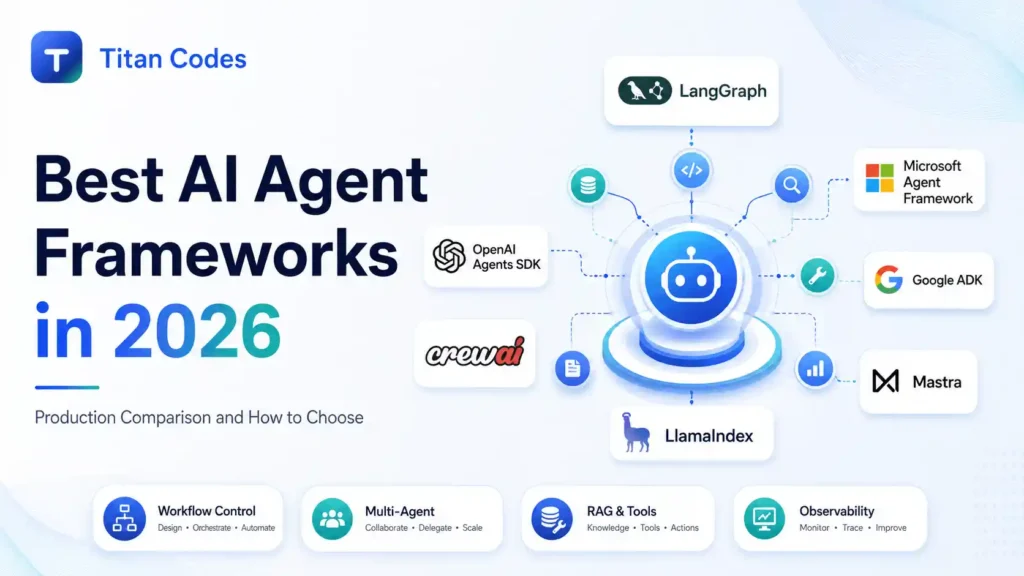
Choosing an AI agent framework was relatively simple a few years ago. Today, developers can choose from LangGraph, CrewAI, OpenAI Agents SDK, Microsoft Agent Framework, Google Agent Development Kit, Claude Agent SDK, LlamaIndex Workflows, Mastra, Smolagents, and a growing number of specialized alternatives.
More choice is useful, but it creates a new problem.
The framework that helps a developer build an impressive demo in two days is not necessarily the framework a company wants running customer support, approving business actions, querying private documents, or updating production systems six months later.
That distinction matters because AI agent adoption is moving quickly. PwC surveyed 300 senior executives in 2025 and found that 79% said AI agents were already being adopted in their companies. Among organizations adopting them, 66% reported measurable productivity gains, while 57% reported cost savings.
At the same time, Gartner predicts that more than 40% of agentic AI projects will be canceled by the end of 2027 because of escalating costs, unclear business value, or inadequate risk controls. Gartner also expects 33% of enterprise software applications to include agentic AI by 2028, compared with less than 1% in 2024.
Those numbers tell two different sides of the same story: AI agents are becoming important, but building them responsibly is much harder than adding an LLM to an application.
The best AI agent framework therefore depends less on which framework has the most GitHub stars and more on what your agent actually needs to do.
For this comparison, we evaluated the leading frameworks around production concerns that matter to businesses and development teams:
- Workflow and orchestration control
- State and memory management
- Human approval capabilities
- Tool and API integration
- RAG and knowledge retrieval
- Observability and debugging
- Model flexibility
- Multi-agent support
- Developer experience
- Deployment and production fit
- Ecosystem maturity
- Potential cost complexity
If your goal is to build a business agent that searches approved knowledge, interacts with APIs, follows permissions, and escalates sensitive actions to people, you can also explore Titan Codes AI agent development services.
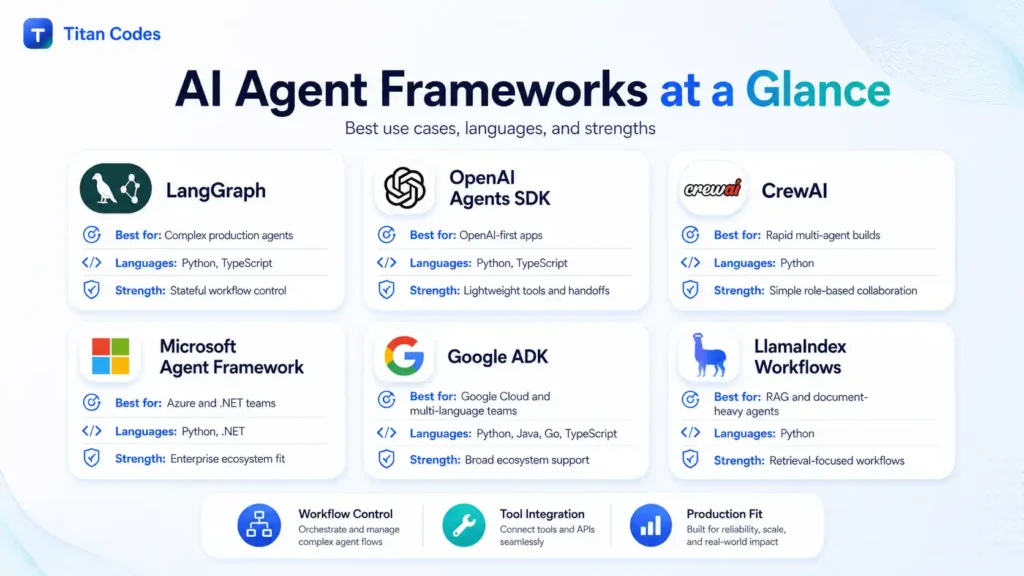
Best AI Agent Frameworks in 2026 at a Glance
| Framework | Best For | Primary Languages | Orchestration Style | Main Strength |
| LangGraph | Complex production agents | Python, TypeScript | Graph-based | Stateful and controlled workflows |
| OpenAI Agents SDK | OpenAI-first agent applications | Python, TypeScript | Agents, tools, handoffs | Low abstraction and strong OpenAI integration |
| Microsoft Agent Framework | Microsoft and Azure ecosystems | Python, .NET | Graph workflows and orchestration patterns | Enterprise and .NET integration |
| CrewAI | Rapid multi-agent development | Python | Roles, crews, flows | Simple multi-agent mental model |
| Google ADK | Google Cloud and multi-language teams | Python, Java, Go, TypeScript and more | Code-first multi-agent | Google ecosystem and broad language support |
| Claude Agent SDK | Coding and computer-use style agents | Python, TypeScript | Agent harness and tools | File, shell, coding, and tool execution |
| LlamaIndex Workflows / LlamaAgents | RAG and document-heavy agents | Python | Event-driven workflows | Data and document workflows |
| Mastra | TypeScript teams | TypeScript | Graph workflows | Full-stack TypeScript developer experience |
| Smolagents | Lightweight experimental agents | Python | Code agents and tool calling | Minimal abstraction |
Quick answer
If you want one short recommendation:
LangGraph is our strongest general recommendation for complex production AI agent orchestration. It provides explicit control over state, workflow transitions, persistence, interruptions, and human approval. Its strength is not simplicity. Its strength is control.
OpenAI Agents SDK is one of the strongest options for teams already building around OpenAI models and wanting a lighter abstraction with agents, tools, guardrails, handoffs, sessions, MCP integrations, and built-in tracing.
Microsoft Agent Framework makes the most sense for Microsoft-centric organizations, especially companies using Azure, .NET, Microsoft AI services, or existing AutoGen and Semantic Kernel projects. Microsoft released Agent Framework 1.0 for Python and .NET in April 2026.
CrewAI remains one of the easiest ways to model teams of specialized AI agents, while Google ADK is compelling for Google Cloud environments, Mastra stands out for TypeScript teams, and LlamaIndex remains particularly relevant when document retrieval is central to the system.
There is no universal winner. The right framework depends on your architecture.
What Is an AI Agent Framework?
An AI agent framework is a software development layer that provides reusable components for building applications in which an AI model can reason about a task, select tools, maintain context, interact with external systems, and complete multi-step workflows.
Without a framework, developers can still build an AI agent directly with model APIs. They would need to implement much of the surrounding logic themselves, including:
- Tool registration
- Tool execution
- State management
- Conversation memory
- Retries
- Routing
- Agent handoffs
- Approval workflows
- Logging
- Error handling
- Evaluation
- Persistence
- Multi-agent coordination
A framework does not make the model smarter. It provides infrastructure around the model.
That difference is important.
A strong model inside a poorly designed agent architecture can still call the wrong API, repeat an action, lose state, use the wrong source, or continue an expensive reasoning loop longer than necessary.
For businesses building custom AI-powered software, the framework is therefore only one piece of the broader architecture. The system may also require APIs, databases, RAG, authentication, cloud infrastructure, monitoring, queues, and business-specific approval logic.
Titan Codes covers these surrounding layers through services such as API development and integration, RAG knowledge base AI development, and cloud services.
How We Evaluated the Best AI Agent Frameworks
A framework should not be judged by how quickly someone can reproduce a tutorial.
Production agents operate in a different environment.
APIs become unavailable. Users provide ambiguous instructions. Documents contain conflicting information. Authentication expires. Models return unexpected tool arguments. Tasks run longer than planned. Human approval may take several hours. A workflow may need to resume after a process restart.
That is why our evaluation focuses on the following areas.
1. Workflow control
Can developers define exactly what happens next when deterministic business rules matter?
Fully autonomous reasoning is useful for open-ended tasks. It is less useful when a refund, account update, compliance check, or database write must follow a specific sequence.
2. State and durable execution
Can the agent remember its workflow state and continue after interruptions?
This becomes important for long-running processes, multi-step approvals, asynchronous tasks, and workflows that should survive application restarts.
3. Human-in-the-loop support
Can a workflow stop before a sensitive action and wait for a person to approve, reject, or modify it?
Deloitte’s 2026 State of AI in the Enterprise research, based on 3,235 leaders across 24 countries, found that only one in five companies had a mature governance model for autonomous AI agents.
Human oversight should therefore be treated as an architecture requirement, not an afterthought.
4. Observability
Can engineers understand why an agent did something?
Useful observability should expose model calls, tool calls, latency, errors, routing decisions, token usage, and workflow state.
An AI system that cannot be investigated when it fails is difficult to operate responsibly.
5. Model flexibility
Some businesses want the freedom to use different model providers.
Others intentionally standardize around one vendor.
Neither strategy is automatically wrong, but the decision should be deliberate.
6. Tool and MCP integration
AI agents become useful when they can interact with software.
That may include CRMs, databases, calendars, ticketing systems, ERP platforms, email systems, internal APIs, file storage, and custom business applications.
Model Context Protocol, or MCP, is increasingly important because it provides a standardized interface for connecting AI systems with external tools and resources.
7. Developer experience
The framework needs to match the team building and maintaining it.
A Python-first framework may be perfect for an ML team and frustrating for a company whose product stack is entirely TypeScript.
A .NET organization may reasonably prefer Microsoft Agent Framework even when another framework offers comparable orchestration capabilities.
1. LangGraph: Best Overall for Complex Production AI Agents
LangGraph is a low-level orchestration framework created by LangChain for building long-running, stateful AI agents.
Rather than hiding workflow behavior inside a high-level agent abstraction, LangGraph lets developers represent the process as state moving through nodes and edges.
That architecture makes it particularly useful when some parts of a workflow should be driven by an LLM while other parts need predictable software logic.
LangGraph’s official documentation highlights durable execution, streaming, persistence, memory, and human-in-the-loop workflows as core capabilities.
Its GitHub repository had more than 37,000 stars at the time of this review, providing a useful signal of developer interest, although GitHub popularity should never be confused with production reliability.
Where LangGraph is strongest
LangGraph is particularly well suited to workflows such as:
- Customer support agents with escalation
- Financial or operational approval workflows
- Long-running research agents
- Multi-stage document processing
- Agents that need persistent state
- Complex RAG workflows
- Multi-agent orchestration
- Systems combining deterministic logic and LLM reasoning
One of its strongest capabilities is interruption and resumption.
A LangGraph application can pause at a specific point, persist its state, wait for external input, and continue later. This makes it useful for approval workflows where an agent prepares an action but a human must authorize execution.
LangGraph and LangChain are not the same thing
This distinction causes frequent confusion.
LangChain is a higher-level framework for building LLM applications and agents.
LangGraph is the lower-level orchestration runtime used when developers need more explicit control over state, workflow behavior, persistence, and long-running processes.
LangChain’s own agent abstractions are built on LangGraph.
LangGraph limitations
The same control that makes LangGraph powerful also creates additional engineering work.
Developers need to understand state design, graph execution, persistence, tool architecture, and failure handling. A simple FAQ assistant does not automatically need LangGraph.
For straightforward agents, it can be more infrastructure than necessary.
LangGraph verdict
Best for: Complex, stateful, production AI agents where control and observability matter more than minimum setup time.
For serious business workflows involving multiple tools, approvals, state transitions, or complex routing, LangGraph belongs on the shortlist.
2. OpenAI Agents SDK: Best for OpenAI-First Agent Development
The OpenAI Agents SDK takes a deliberately lightweight approach.
Its core abstractions revolve around agents, tools, handoffs, guardrails, and a runner that manages execution.
The SDK also includes sessions, human-in-the-loop capabilities, MCP integration, and built-in tracing.
OpenAI’s Python Agents SDK had more than 27,000 GitHub stars at the time of review.
Where OpenAI Agents SDK is strongest
The SDK makes sense when a development team wants to stay close to the model layer rather than adopting a large orchestration abstraction.
Common use cases include:
- Support assistants
- Sales agents
- Research assistants
- Tool-calling agents
- Voice agents
- Agent handoff systems
- Multi-agent delegation
- Internal copilots
Built-in tracing records LLM generations, tool calls, handoffs, guardrails, and custom events, giving teams a useful debugging foundation without requiring a separate tracing system for initial development.
Is OpenAI Agents SDK locked to OpenAI models?
Not completely.
This point is often oversimplified.
OpenAI models receive the most direct integration, but the current SDK also provides integration paths for non-OpenAI models, including custom model providers and third-party adapters such as LiteLLM. OpenAI does caution developers that features can differ between providers.
That means the SDK can support multi-provider architectures, but teams should test provider-specific behavior instead of assuming complete feature parity.
OpenAI Agents SDK limitations
For workflows with deeply explicit graph logic, checkpoint-heavy orchestration, or many deterministic branches, a graph framework may provide clearer control.
The SDK is strongest when agent delegation and tool execution are the core architecture rather than a large business-process graph.
OpenAI Agents SDK verdict
Best for: Teams building OpenAI-centric applications that want a clean agent runtime with minimal abstraction.
It is especially attractive when the workflow is agent-first rather than workflow-first.
3. Microsoft Agent Framework: Best for Microsoft and .NET Teams
Microsoft Agent Framework is one of the most important changes in the 2026 agent framework landscape.
Microsoft released Agent Framework 1.0 for both Python and .NET on April 3, 2026, describing it as the production-ready framework that combines enterprise foundations associated with Semantic Kernel and multi-agent orchestration ideas from AutoGen.
This is important because many older framework lists still recommend AutoGen as Microsoft’s primary framework.
For teams starting a new Microsoft-centric agent project in 2026, Agent Framework deserves evaluation before AutoGen.
What Microsoft Agent Framework provides
The framework includes support for multiple orchestration patterns:
- Sequential
- Concurrent
- Handoff
- Group chat
- Magentic-style coordination
It also supports human approval workflows.
Microsoft’s workflow system lets developers explicitly define execution graphs when business logic should determine the path rather than allowing the LLM to decide everything dynamically.
Checkpointing can preserve workflow state so processes can resume after an interruption or restart.
Where Microsoft Agent Framework is strongest
It is particularly attractive for:
- .NET development teams
- Azure environments
- Enterprise Microsoft stacks
- Organizations migrating from AutoGen
- Organizations migrating from Semantic Kernel
- Multi-agent systems that need explicit workflows
- Teams using OpenTelemetry and enterprise observability
Microsoft Agent Framework limitations
Its greatest advantages appear in Microsoft-centric environments.
A Python startup running primarily on AWS or GCP may have less reason to adopt it unless specific framework capabilities are attractive.
Microsoft Agent Framework verdict
Best for: Enterprises using Azure, Microsoft AI infrastructure, Python and .NET systems, or existing AutoGen and Semantic Kernel projects.
4. CrewAI: Best for Fast Role-Based Multi-Agent Development
CrewAI became popular because its mental model is easy to understand.
Instead of starting with graphs, developers create agents with specific roles and responsibilities, then organize those agents into a crew.
A researcher can research. An analyst can analyze. A writer can produce content. A reviewer can validate the result.
That structure maps naturally to many business processes.
CrewAI had more than 53,000 GitHub stars at the time of this review, giving it one of the largest developer communities among dedicated agent frameworks.
CrewAI Crews and Flows
CrewAI now extends beyond simple role-based crews.
Its documentation separates the platform into Crews for collaborative autonomous agents and Flows for more structured, event-driven orchestration. Flows can manage state, persist execution, and resume long-running workflows. CrewAI also documents guardrails, memory, knowledge, observability, and human-in-the-loop capabilities.
That makes modern CrewAI more capable than early comparisons sometimes suggest.
Where CrewAI is strongest
CrewAI works particularly well for:
- Research workflows
- Content pipelines
- Market analysis
- Internal analysis teams
- Multi-perspective synthesis
- Rapid multi-agent prototypes
- Business workflows that naturally map to specialized roles
CrewAI limitations
Role-based abstractions can become harder to reason about when agents are given substantial freedom to delegate and coordinate.
For tightly regulated processes, a more explicit workflow graph may still be easier to audit and debug.
CrewAI verdict
Best for: Teams that want to build multi-agent systems quickly using an intuitive role-based model.
CrewAI is no longer only a prototyping framework, but developers should still decide carefully how much autonomy they want agents to have.
LangGraph vs CrewAI: Which Is Better?
This is one of the most common comparisons in AI agent development.
The answer depends on how you think about the workflow.
Choose LangGraph when the process itself matters. You want explicit state, clear routing, persistence, checkpoints, and controlled execution.
Choose CrewAI when the roles matter. You want specialized AI agents to collaborate around defined responsibilities.
For example, a competitive research workflow could work naturally in CrewAI:
Research Agent → Market Analyst → Strategy Agent → Report Writer
A claims-processing system may make more sense in LangGraph:
Receive Claim → Validate Data → Retrieve Policy → Risk Check → Human Review → Approved Action
Both frameworks can support sophisticated systems. They simply begin from different abstractions.
5. Google Agent Development Kit: Best for Google Cloud and Multi-Language Teams
Google’s Agent Development Kit, commonly called ADK, is an open-source framework for building agents and multi-agent systems.
Google initially launched ADK in 2025 and has expanded it aggressively across programming languages and cloud integrations.
By 2026, Google had released ADK implementations across Python, Java, Go, and TypeScript, with additional Kotlin development.
The Python repository had almost 20,000 GitHub stars in the latest snapshot reviewed for this article.
Where Google ADK is strongest
ADK is particularly relevant for:
- Google Cloud environments
- Gemini-based agent systems
- Vertex AI deployments
- Multi-agent workflows
- Teams needing multiple programming languages
- Agent-to-agent communication
- Systems using Google services and data infrastructure
Google has also been expanding ADK’s integration ecosystem so agents can work with external developer tools, APIs, and business systems.
Its Go release includes OpenTelemetry integration, human-in-the-loop confirmations, and multi-agent execution patterns such as sequential, parallel, and loop agents.
Google ADK limitations
ADK can run outside Google Cloud, but its strongest advantages naturally appear when the surrounding infrastructure is already part of Google’s ecosystem.
Teams should therefore distinguish between “can run elsewhere” and “best operational fit.”
Google ADK verdict
Best for: Google Cloud and Gemini-focused organizations that want a code-first, multi-language agent framework.
6. Claude Agent SDK: Best for Coding and Tool-Heavy Autonomous Agents
Anthropic’s Claude Agent SDK takes a somewhat different approach from general orchestration frameworks.
It exposes capabilities associated with Claude Code so developers can build agents that work with files, execute commands, modify code, use tools, and complete longer-running technical workflows programmatically.
The SDK is available for Python and TypeScript.
Where Claude Agent SDK is strongest
The framework is especially interesting for:
- Coding agents
- Developer tooling
- Repository analysis
- File manipulation
- Terminal-based automation
- Software maintenance workflows
- Research agents that need extensive tool access
The Python SDK bundles the Claude Code CLI and provides access to tools such as file reading, writing, editing, and shell execution. It also supports custom tools through MCP-based mechanisms.
Claude Agent SDK limitations
Claude Agent SDK is closely tied to Claude and the Claude Code agent environment.
That makes it highly capable for the workloads it targets, but companies looking primarily for model-independent business process orchestration may prefer LangGraph, Microsoft Agent Framework, CrewAI, or another general-purpose framework.
Claude Agent SDK verdict
Best for: Coding agents and tool-heavy autonomous workflows where Claude’s development environment is a strong fit.
7. LlamaIndex Workflows and LlamaAgents: Best for RAG and Document-Heavy Agents
LlamaIndex built its reputation around connecting language models to private and domain-specific data.
That history still matters.
The current LlamaAgents project is built around Agent Workflows, an event-driven, asynchronous orchestration model in which workflow steps emit and consume events. It supports branching, loops, parallel execution, persistence, and recovery from failures.
Where LlamaIndex is strongest
LlamaIndex becomes particularly interesting when the core problem involves:
- Large document collections
- Enterprise knowledge bases
- RAG
- OCR
- Data extraction
- Document classification
- Document review
- Knowledge-intensive agents
Its broader ecosystem includes retrieval, indexing, connectors, document parsing, and more than 300 integration packages around LlamaIndex core.
That makes it a natural fit when retrieval quality is a major part of the project rather than simply one tool available to the agent.
LlamaIndex limitations
If the agent does very little retrieval, another framework may provide a more direct orchestration experience.
A customer service workflow that mostly updates CRM records, sends emails, and routes approvals may not need LlamaIndex as its primary framework.
LlamaIndex verdict
Best for: Document-heavy AI agents, knowledge assistants, enterprise search, and RAG systems.
Businesses planning this type of solution can also review Titan Codes’ guide to RAG knowledge base AI services to understand the surrounding retrieval architecture.
8. Mastra: Best AI Agent Framework for TypeScript Teams
Mastra is a TypeScript-first framework for building AI agents and AI-powered applications.
That alone makes it significant.
Much of the agent framework ecosystem began in Python, while many SaaS products, web applications, and startup engineering teams build heavily in TypeScript.
Mastra gives those teams an agent stack that feels native to their existing ecosystem.
Its GitHub repository had more than 24,000 stars at the time of review.
What Mastra includes
Mastra combines:
- Agents
- Workflows
- Memory
- Observability
- Evals
- MCP support
- Model routing
- TypeScript development
Its graph-based workflows support sequential steps, parallel execution, branching, loops, and suspend-and-resume behavior.
Mastra also provides tracing around agent decisions, LLM operations, token usage, latency, tools, and memory.
Where Mastra is strongest
Mastra is worth evaluating for:
- TypeScript SaaS applications
- Next.js applications
- Node.js backends
- AI features inside existing JavaScript products
- Agent workflows requiring memory and observability
- Teams that prefer a unified framework
Mastra limitations
Teams centered around Python data pipelines or mature ML infrastructure may gain less from its TypeScript-first design.
Its relatively opinionated ecosystem is an advantage when those opinions match your application and a constraint when they do not.
Mastra verdict
Best for: TypeScript and JavaScript teams building agents inside modern web and SaaS products.
9. Smolagents: Best Lightweight AI Agent Framework
Hugging Face’s Smolagents is intentionally small.
Instead of introducing a large orchestration platform, Smolagents focuses on minimal abstractions around agents and tools.
Its most distinctive capability is CodeAgent, where the model expresses actions using executable code rather than relying entirely on JSON-style function calls.
The project had more than 27,000 GitHub stars in the repository snapshot reviewed for this guide.
What makes Smolagents different?
Smolagents supports:
- Code-based agent actions
- Standard tool-calling agents
- Multiple model providers
- Local models
- MCP tools
- Multi-agent examples
- Sandboxed code execution
Hugging Face describes the library as model-agnostic and supports model access through providers such as OpenAI and Anthropic as well as local Transformers and Ollama deployments.
Smolagents limitations
The documentation itself labels the API experimental and subject to change.
That does not make it unsuitable for serious experimentation, but businesses should evaluate API stability and operational requirements before using it as the foundation for a long-lived enterprise system.
Smolagents verdict
Best for: Developers who want lightweight, understandable agent abstractions and code-driven experimentation.
Which AI Agent Framework Is Best for Different Use Cases?
The fastest way to choose a framework is to start with the system you are building rather than the framework you want to use.
| Use Case | Frameworks to Evaluate First |
| Complex stateful business workflow | LangGraph |
| OpenAI-first assistant | OpenAI Agents SDK |
| Azure or .NET enterprise system | Microsoft Agent Framework |
| Role-based multi-agent system | CrewAI |
| Google Cloud agent | Google ADK |
| Coding or repository agent | Claude Agent SDK |
| RAG and document agent | LlamaIndex |
| TypeScript SaaS agent | Mastra |
| Lightweight code agent | Smolagents |
| Human approval-heavy workflow | LangGraph, Microsoft Agent Framework |
| Multi-provider architecture | LangGraph, CrewAI, Mastra, Smolagents |
| Rapid prototype | CrewAI, OpenAI Agents SDK, Smolagents |
OpenAI Agents SDK vs LangGraph
Another common question is whether teams should choose OpenAI Agents SDK or LangGraph.
The simplest distinction is this:
OpenAI Agents SDK is agent-centric. LangGraph is workflow-centric.
Use OpenAI Agents SDK when agents, handoffs, tools, and model interactions make up most of the application.
Use LangGraph when you need a clearly defined state machine around those agent interactions.
Consider a lead qualification agent.
The agent receives an inquiry, determines intent, searches company information, asks questions, and creates a CRM record.
OpenAI Agents SDK could handle that architecture cleanly.
Now add:
- Separate verification
- Compliance screening
- CRM lookup
- Duplicate detection
- Pricing approval
- Human review
- CRM update
- Follow-up scheduling
- Retry logic
- Persistent workflow state
At that point, explicit graph orchestration becomes increasingly attractive.
Neither architecture is universally better. Complexity determines the answer.
What About Microsoft AutoGen?
AutoGen still appears prominently in many AI agent framework comparisons.
That makes sense historically. It was one of the frameworks that helped popularize multi-agent conversation architectures.
However, Microsoft’s framework strategy has changed.
Microsoft Agent Framework 1.0 is now the company’s unified framework direction for new agent development across Python and .NET, bringing together ideas and capabilities associated with AutoGen and Semantic Kernel.
Existing AutoGen projects do not suddenly become useless. But if you are selecting a Microsoft framework for a new long-term project, evaluate Microsoft Agent Framework first.
This is one area where AI framework comparison articles can become outdated quickly.
Do You Actually Need a Multi-Agent System?
Not always.
One of the easiest mistakes in agent development is assuming that more agents create a better system.
A multi-agent architecture introduces more:
- Model calls
- Routing decisions
- State
- Prompt configurations
- Failure points
- Token usage
- Debugging complexity
- Coordination overhead
If one agent with five well-designed tools can complete the workflow reliably, adding five specialized agents may make the system worse rather than better.
Microsoft’s own current framework guidance recommends starting with simpler patterns before moving into workflows when simpler agent architectures can meet the requirement.
The same principle applies across frameworks.
Start with the simplest architecture that can reliably solve the task.
Add orchestration when the workflow proves that it needs orchestration.
How AI Agent Framework Choice Affects Development Cost
Most of the frameworks discussed in this article are open source or offer open-source core components.
That does not mean the AI agent itself is free to build or operate.
Framework cost is usually a small part of total cost.
The larger expenses come from:
- AI model usage
- Software engineering
- API integrations
- Data preparation
- Vector databases
- Observability
- Evaluation
- Cloud infrastructure
- Security
- Testing
- Maintenance
- Human review systems
Architecture also affects inference cost.
An agent that makes one model request per task can have a very different cost profile from a multi-agent workflow that makes 15 requests, performs multiple retrieval operations, and repeats a reasoning loop.
This is why cost controls should be designed at the workflow level.
Developers should monitor:
- Model calls per task
- Input tokens
- Output tokens
- Retrieval operations
- Tool calls
- Retries
- Loop count
- Average task duration
- Cost per successful outcome
If you are budgeting a custom build, see Titan Codes’ detailed guide to AI agent development cost.
What Matters More Than the AI Agent Framework
Framework comparisons are useful, but framework choice is not the largest determinant of success.
A well-chosen framework cannot compensate for a badly designed system.
Clear agent boundaries
Define what the agent is allowed to do and what it should never do.
A support agent may be allowed to retrieve an order and draft a refund response while being prohibited from issuing the refund without approval.
Those boundaries should exist in software and permissions, not only inside a prompt.
Good tool design
Tools should perform clear, limited actions.
Instead of giving an agent unrestricted database access, expose specific operations such as:
get_customer_record
find_open_orders
prepare_refund_request
create_support_note
request_manager_approval
Narrow tools make behavior easier to validate and audit.
Reliable API integrations
An AI agent that cannot reliably interact with business software is still mostly a chatbot.
Production agents often depend on CRM systems, billing platforms, ticketing systems, calendars, databases, internal APIs, and third-party SaaS products.
The integration layer therefore deserves the same engineering discipline as the agent layer.
Titan Codes API development and integration services focus on authentication, data mapping, errors, retries, logging, and documentation around those connections.
Quality knowledge retrieval
If an agent answers questions using company documents, retrieval quality becomes critical.
The model should receive the right information, not simply more information.
A useful RAG architecture requires decisions around:
- Source quality
- Document cleaning
- Chunking
- Metadata
- Embeddings
- Search
- Reranking
- Access permissions
- Citations
- Refresh schedules
- Evaluation
This is why RAG should be treated as its own engineering layer.
Human approval
Do not treat “autonomous” as the default goal.
A good business agent should be autonomous where autonomy is safe and efficient, and supervised where judgment or irreversible actions matter.
Examples that may require approval include:
- Refunds
- Payments
- Contract actions
- Deleting records
- Account changes
- External communications
- Sensitive data access
- Pricing exceptions
Evaluation
Testing an agent by chatting with it for 20 minutes is not enough.
Build a representative evaluation set.
For a customer support agent, that could include:
- Common questions
- Ambiguous questions
- Missing data
- Incorrect assumptions
- Angry customers
- Sensitive requests
- Tool failures
- Unsupported requests
- Prompt injection attempts
- Escalation scenarios
Run the evaluation whenever prompts, models, tools, knowledge, or workflows change.
Observability
Logs tell you what your software did.
Agent traces should tell you why a model selected an action, which tools it used, what context it received, and how the workflow progressed.
Production teams need both.
Can You Mix Multiple AI Agent Frameworks?
Yes, but do it for a reason.
Frameworks do not have to be mutually exclusive.
A company could use LlamaIndex for document retrieval and LangGraph for orchestration.
A TypeScript application could expose a service written in another framework through an API or MCP interface.
A specialized coding agent could operate as one component inside a larger business workflow.
However, combining frameworks adds complexity.
Every additional runtime introduces new dependencies, tracing behavior, state models, upgrades, and debugging surfaces.
Mix frameworks when the architectural benefit is clear, not because every framework has an interesting feature.
How to Choose an AI Agent Framework for Your Business
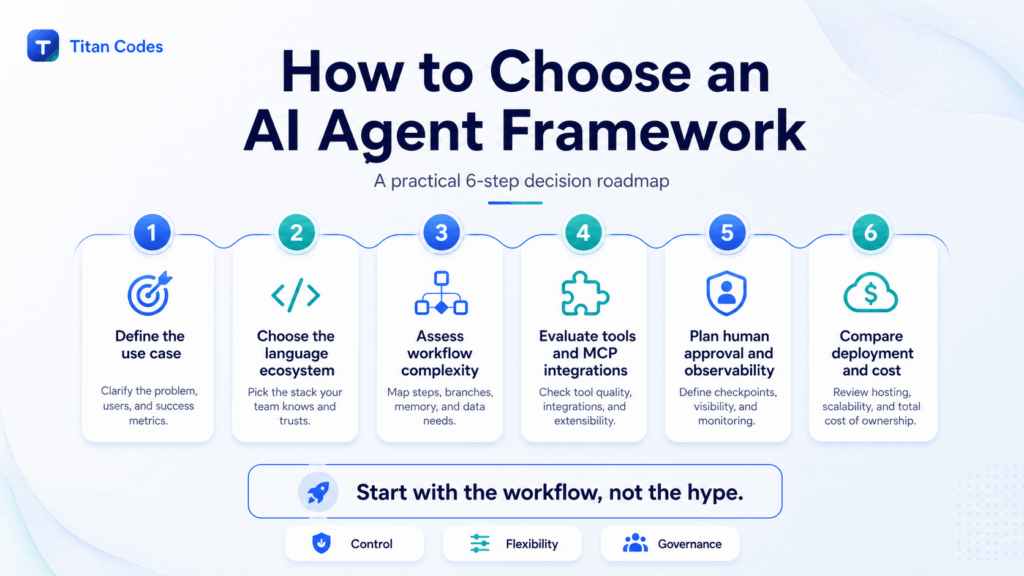
Before selecting an AI agent development framework, answer these questions.
What does the agent need to do?
List the actual business actions.
“Build an AI agent” is not a requirement.
“Read incoming support tickets, retrieve order history, search policy documentation, draft a response, and send refunds above $100 for manager approval” is a requirement.
Which actions can run automatically?
Separate low-risk actions from sensitive actions.
Search may run automatically.
Drafting may run automatically.
Sending or updating may require approval.
How long can workflows run?
A five-second assistant and a three-day approval workflow need different state architectures.
If workflows can pause for hours or days, persistence matters.
Does the business need multiple model providers?
If switching between providers is part of the strategy, evaluate that capability before implementation.
Do not assume model portability will be effortless after the application is built.
Where does the business knowledge live?
If the agent depends on thousands of documents, a strong retrieval layer may matter more than the orchestration framework.
What technology does the existing team use?
A TypeScript organization should seriously evaluate Mastra and TypeScript-supported SDKs.
A .NET company should evaluate Microsoft Agent Framework.
A Python AI team will have the broadest range of framework options.
How will the system be monitored?
Decide how the team will inspect:
- Model calls
- Tool calls
- Failures
- Latency
- Token usage
- User feedback
- Retrieval quality
- Escalations
- Costs
before launch, not after the first production incident.
Our AI Agent Framework Recommendations
There is no single framework we would recommend for every business.
For complex production orchestration, LangGraph is one of the strongest choices because its state and execution model give developers explicit control.
For OpenAI-centered products, OpenAI Agents SDK provides a clean and increasingly capable agent runtime without unnecessary abstraction.
For Microsoft environments, Microsoft Agent Framework should now be evaluated ahead of building a new system directly on AutoGen.
For teams that need rapid multi-agent development, CrewAI remains compelling.
For Google Cloud, Google ADK provides a strong first-party path.
For RAG-heavy systems, LlamaIndex deserves serious consideration.
For TypeScript products, Mastra offers one of the most natural developer experiences.
For lightweight experimentation, Smolagents is refreshingly small.
For coding and computer-style tool execution, Claude Agent SDK provides capabilities that general business orchestration frameworks do not necessarily target.
The important point is this:
Do not choose the framework first. Choose the architecture first.
Then select the framework that makes that architecture easier to build, test, operate, and maintain.
How Titan Codes Approaches AI Agent Development
At Titan Codes, the goal of AI agent development is not maximum autonomy.
The goal is useful automation with enough control to operate safely inside a real business.
A production agent architecture may include:
- A clearly defined agent role
- Approved business knowledge
- Restricted tools and API permissions
- Workflow state
- RAG where private knowledge is required
- Human approval for sensitive actions
- Error and fallback paths
- Scenario testing
- Logging and tracing
- Cloud deployment and monitoring
Framework selection comes after those requirements are understood.
That approach is consistent with Titan Codes’ broader development process, which starts with scope and architecture before implementation.
Depending on the project, a complete system may combine AI agent development, RAG knowledge base AI, API integrations, custom software development, and cloud deployment.
The framework should support the product architecture, not dictate it.
Final Thoughts
AI agent frameworks have matured quickly.
Developers now have serious options from independent open-source projects, cloud providers, model companies, and established enterprise software vendors.
That competition is good for businesses.
It also makes technical selection more complicated.
The best framework for your project is not necessarily the framework that produces the fastest demo, has the most GitHub stars, or appears in the most tutorials.
Ask instead:
Can we control the workflow?
Can we understand what happened when it fails?
Can we limit what the agent is allowed to do?
Can we pause sensitive actions for review?
Can we measure quality?
Can we monitor cost?
Can we maintain the system two years from now?
Those questions will tell you more about production readiness than any framework leaderboard.
If you are still exploring whether agents are the right solution, Titan Codes’ guides to AI automation for small businesses and the role of AI in software development provide useful starting points.
If you already have a workflow in mind, Titan Codes can help map the agent role, knowledge sources, tools, integrations, approval logic, architecture, testing strategy, and deployment path before development begins.
FAQs About AI Agent Frameworks
-
What is the best AI agent framework in 2026?
LangGraph is one of the strongest general-purpose options for complex production AI agents because it provides explicit workflow control, persistent state, durable execution, streaming, and human-in-the-loop capabilities. However, the best framework depends on your stack and use case. OpenAI Agents SDK may be better for OpenAI-first applications, Microsoft Agent Framework for Azure and .NET teams, LlamaIndex for document-heavy RAG agents, and Mastra for TypeScript products.
-
Which AI agent framework is best for RAG?
LlamaIndex is particularly strong for retrieval and document-centric applications. LangGraph is also frequently suitable for orchestrating complex RAG workflows. In many systems, retrieval architecture matters more than the specific agent framework.
-
Do I need an AI agent framework?
Not always. Simple applications can often be built directly with model APIs and function calling. Frameworks become more useful when you need multi-step workflows, persistent state, multiple agents, human approvals, complex tool use, memory, retries, or observability.
-
How much does it cost to build an AI agent?
AI agent development cost depends on the number of workflows, integrations, model usage, RAG requirements, security, infrastructure, testing, autonomy, and monitoring. A simple proof of concept costs far less than an enterprise system connected to multiple business platforms. See Titan Codes AI agent development cost guide for a detailed breakdown.
-
What should businesses test before deploying an AI agent?
Businesses should test normal requests, ambiguous instructions, incorrect inputs, missing data, tool failures, permission boundaries, prompt injection attempts, sensitive actions, human handoffs, latency, model cost, retrieval quality, and fallback behavior before production deployment.
-
Are AI agents replacing traditional automation?
Not entirely. Traditional automation remains better for predictable rules such as “when X happens, do Y.” AI agents become useful when a workflow requires interpreting language, selecting between actions, retrieving context, or making bounded decisions. Many production systems combine both approaches.